Our authors (2013, 3)

Abramov Vladimir K.,
Doctor of History, Professor, Chair of Russian History, Mordovia N.P. Ogarev State University (Saransk, Russia), abramovvk@mail.ru

Arekeeva Svetlana T.,
Cand. Sc. {Pedagogics}, Docent, Chair of Udmurt Literature and the Literatures of the Peoples of Russia, Udmurt State University (Izhevsk, Russia), sveta.arekeeva@gmail.com

Bahlova Olga V.,
Doctor of Political Sciences, Professor, Chair of General History and World Political Process, N.P. Ogarev State University (Saransk, Russia), olga.bahlova@gmail.com

Belyaeva Nadezhda F.,
Doctor of History, Professor, Research Fellow, Institute of History and Sociology, N.P. Ogarev State University (Saransk, Russia), general_history@mordgpi.ru

Burnaev Alexander G.,
Doctor of Arts, Professor, Head of the National Choreography Chair, N.P. Ogarev State University (Saransk, Russia), burnaevag@mail.ru

Vaganova Elena N.,
Cand. Sc. {Philology}, Docent, Department of Foreign Languages for Science and Engineering, N.P. Ogarev Mordovia State University (Saransk, Russia), waganowa@mail.ru

Vasina Tatiana A.,
Cand. Sc. {History}, Research Fellow, Udmurt Institute of History, Language and Literature, Ural Branch of the Russian Academy of Sciences (Izhevsk, Russia), tatjasch@mail.ru

Gudkova Svetlana P.,
Doctor of Philology, Professor, Chair of Russian and Foreign Literature, N.P. Ogarev Mordovia State University (Saransk, Russia), sveta_gud@mail.ru

Zaitseva Tatiana I.,
Cand. Sc. {Philology}, Docent, Head of the Chair of Udmurt Literature and the Literatures of the Peoples of Russia, Udmurt State University (Izhevsk, Russia), uawoz@rambler.ru

Zubarev Michael E.,
III year post-graduate student, Chair of Management of Socio-Political processes, Komi Republican Academy of Public Administration and Management (Syktyvkar, Russia), miha-zubarev@rambler.ru

Kalachina Larisa V.,
Executive secretary of the academic and publicistic journal “Regional Studies”, Cand. Sc. {Cultural Studies} (Saransk, Russia), regionologiya_lk@mail.ru

Komarov Kirill V.,
Post-graduate student, Chair of History of Russia, N.P.Ogarev State University (Saransk, Russia), kirill-komarov@mail.ru

Kornishina Galina A.,
Doctor of History, Professor, Chair of History of Russia, N.P. Ogarev State University (Saransk, Russia), kornihina@rambler.ru

Martinchuk Tatiana A.,
Methodist, teacher, I. A. Kuratov Syktyvkar Humanitarian Pedagogical College ( Syktyvkar , Russia), martynchukt@mail.ru

Mosina Natalia M.,
Cand. Sc. {Philology}, Associate Professor, Department of Finno-Ugric and Comparative Linguistics, N.P.Ogarev Mordovia State University (Saransk, Russia), natamish@rambler.ru

Panova Margarita V.,
Post-graduate student, A. Herzen Russian State Pedagogical University (Saint-Petersburg, Russia), margarita.panova@mail.ru

Radzetskaya Olga V.,
Cand. Sc. {Cultural Studies}, Docent, Maimonides State Classical Academy (Moscow, Russia),olgabreman@yandex.ru

Rebrova Tatyana P.,
Cand. Sc. {History}, Head of State and Administrative Law Chair, Mordovia Institute for the Humanities (Saransk, Russia), rebrova@yandex.ru

Rodniakov Aleksei V.,
Deputy Head of the Interregional Academic Center of Finno-Ugric Studies, Mordovia N.P. Ogarev State University (Saransk, Russia), aleviro@mail.ru

Ruskina Elena S.,
Research Fellow, Mordovia Republic State establishment “Academic Center for Social and Economic Monitoring” (Saransk , Russia ), redizd@mail.ru

Tanaseychuk Andrei B.,
Doctor of Cultural Studies, Professor, Chair of Russian and Foreign Literature, N.P. Ogarev Mordovia State University (Saransk, Russia), atandet@yandex.ru

Trifonova Elena K.,
Cand. Sc. {History}, Docent, Chair of History of Russia and Foreign Countries, Syktyvkar State University (Syktyvkar, Russia ), doc@krags.ru

Fedina Marina S.,
Cand. Sc. {Philology}, Docent, Chair of Archivistics, Record Management and Applied Linguistics, Komi Republican Academy of Public Administration and Management (Syktyvkar, Russia), m-fedina@mail.ru

Fokina Alla A.,
Senior Lecturer, Chair of Foreign Language Communication, Mari State University (Yoshkar-Ola, Russia), allafokina70@mail.ru

Hudoykina Tatiana V.,
Doctor of Law, Head of Legal Disciplines Chair, N.P. Ogarev Mordovia State University (Saransk, Russia), thudoykina@mail.ru

Sheyanova Svetlana V.,
Cand. Sc. {Philology}, Docent, Chair of Finno-Ugric Literatures, N.P. Ogarev Mordovia State University (Saransk, Russia), sheyanovas@mail.ru

Yuzykayn Tatiana V.,
Fellow applicant, Sector of National History, Institute of Language, Literature and History, Komi Scientific (Syktyvkar, Russia), tatyana_juzykain@mail.ru
Posted in 2013, Archives, № 3 (16) | Tagged , | Comments Off on Our authors (2013, 3)

Our authors (2013, 2)

Abdrashitova Irina V.,
Cand. Sc. {Philosophy}, Post-doctoral Researcher, Department of Philosophy for the Humanities, Senior Research Fellow, N. P. Ogarev Mordovia State University (Saransk, Russia), irinaabd@list.ru

Agafonova Nina A.,
Cand. Sc. {Philology}, Docent, Department of the Erzya Language, N.P. Ogarev Mordovia State University (Saransk, Russia), ohanina@rambler.ru

Ageeva Galina M.,
Cand. Sc. {Cultural Studies}, Docent, Department of Library and Information Resources, Institute of National Culture N. P. Ogarev Mordovia State University (Saransk, Russia), ageevagm@rambler.ru

Antipkina Elena N.,
Cand. Sc. {Philosophy}, Docent, Department of Cultural Studies, Ethnic Culture and Performing Arts, Institute of National Culture N. P. Ogarev Mordovia State University (Saransk, Russia), elena.antipkina@mail.ru

Antonov Yuri G.,
Doctor of Philology, Head of the Department of Finno-Ugric Literature, N.P. Ogarev Mordovia State University (Saransk, Russia), antonov-ug69@yandex.ru

Belomoeva Olga G.,
Doctor of Philosophy, Professor, Head of the Department of the Traditional Mordovian Culture, Institute of National Culture, N.P. Ogarev Mordovia State University (Saransk, Russia), o_belomoeva@mail.ru

Bulycheva Arina A.,
Docent, Department of Library and Information Resources, Institute of National Culture, N. P. Ogarev Mordovia State University (Saransk, Russia), bulychevaaa@yandex.ru

Burlankov Stepan P.,
Doctor of Economyc, Professor, Department of Technical Service of Vehicles, N.P. Ogarev Mordovia State University (Saransk, Russia), spbur1@rambler.ru

Busalova Svetlana G.,
Cand. Sc. {Economics}, Docent, Department of Finance and Credit, N.P. Ogarev Mordovia State University (Saransk, Russia), sbusalova@yandex.ru

Vantsova Tatiana G.,
Cand. Sc. {Philology}, Docent, Head of Academic and Creative Arts Laboratory, Institute of National Culture, N. P. Ogarev Mordovia State University (Saransk, Russia), vancova_tatyana@mail.ru

Egey Emese,
PhD {Philosophy}, Docent, Department of Uralic Languages, West-Hungarian University (Szombathely, Hungary), janos_pusztay@hotmail.com

Eliseeva Julia A.,
Doctor of Philosophy, Docent, Head of the Department of Library and Information Resources, Institute of National Culture, N.P.OgarevMordoviaStateUniversity (Saransk, Russia), eliseewayu@rambler.ru

Yeremeev Alexander D.,
Cand. Sc. {Philosophy}, Professor, Department of Cultural Studies, Ethnic Culture and Performing Arts, Institute of National Culture, N. P. Ogarev Mordovia State University (Saransk, Russia), +7 8342 4792 96

Zhebratkina Irina Ja.,
Researcher, Department of the Moksha Language, N.P. Ogarev Mordovia State University(Saransk, Russia), miss.zhebratkina@mail.ru

Zahvatova Irina V.,
Post-graduate Student, Department of Technical Service of Vehicles, N.P. Ogarev Mordovia State University (Saransk, Russia), iriskinz@inbox.ru

Ivanova Galina S.,
Doctor of Philology, Professor, Department of the Moksha Language, N.P. Ogarev Mordovia State University (Saransk, Russia), galina17-05@yandex.ru

Ishmuratov Anatoly V.,
Cand. Sc. {Pedagogy}, Docent, Director of the Finno-Ugric Research and Education Center for Humanitarian Technologies, Udmurt State University (Izhevsk, Russia), rvkir@mail.ru

Kerezsi Agnes,
PhD {History}, Senior Research Fellow, Ethnographic Museum, Budapest (Budapest, Hungary), kerezsi.agnes@gmail.com

Kirillova Rosa V.,
Cand. Sc. {Philology}, Senior Research Fellow, Finno-Ugric Research and Education Center for Humanitarian Technologies, Udmurt State University (Izhevsk, Russia), rvkir@mail.ru

Kirosova Natalia V.,
Senior Lecturer, Department of Documentation, Archival Science and Applied Linguistics, Komi Republican Academy of Public Administration and Management (Syktyvkar, Russia), knata2409@yandex.ru

Klyuyeva Irina V.,
Cand. Sc. {Philosophy}, Professor, Department of Cultural Studies, Ethnic Culture and Performing Arts, Institute of National Culture, N. P. Ogarev Mordovia State University (Saransk, Russia), klyueva_irina@mail.ru

Klyukina Tatyana V.,
Cand. Sc. {Cultural Studies}, Docent, Department of Library and Information Resources, Institute of National Culture, N. P. Ogarev Mordovia State University (Saransk, Russia), klukinatv@rambler.ru

Korsakova Ljubov E.,
Cand. Sc. {Philology}, Docent, Department of Philosophy, History and Pedagogy, Cheboksary Cooperative Institute (branch), Russian University Cooperation (Cheboksary, Russia), korsakova-29@mail.ru

Koshman Tatyana V.,
Senior Lecturer, Department of Archeology and Ethnology, L.N. Gumilev Eurasian National University (Astana, Kazakhstan), tatyanakoshman@mail.ru

Loginova Marina V.,
Doctor of Philosophy, Professor, Department of Cultural Studies, Ethnology and Performing Arts, Institute of National Culture, N.P. Ogarev Mordovia State University (Saransk, Russia), marina919@mail.ru

Lomshina Elena N.,
Cand. Sc. {Philosophy}, Docent, Head of Research Laboratory of the Finno-Ugric Culture,
N.P. Ogarev Mordovia State University (Saransk, Russia), enlomshina@mail.ru

Makarkin Nikolai P.,
Doctor of Economy, Professor, Head of the Department of Economy and Management, the President of N. P. Ogarev Mordovia State University (Saransk, Russia), makarkin@mrsu.ru

Makeykina Svetlana M.,
Cand. Sc. {Economics}, Docent, Department of Finance and Credit, N.P. Ogarev Mordovia State University (Saransk, Russia), makeikinasm@yandex.ru

Maslova Alina Yu.,
Doctor of Philology, Professor, Department of the Russian Language, N.P. Ogarev Mordovia State University (Saransk, Russia), al_mas@mail.ru

Mitrokhin Vladimir V.,
Cand. Sc. {Economics}, Head of the Department of Finance and Credit, N.P. Ogarev Mordovia State University (Saransk, Russia), mitrokhin_vlad@mail.ru

Mosina Natalia M.,
Cand. Sc. {Philology}, Associate Professor, Department of Finno-Ugric and Comparative Linguistics, N.P. Ogarev Mordovia State University (Saransk, Russia), natamish@rambler.ru

Mochalova Tatiana I.,
Cand. Sc. {Philology}, Docent, Department of the Russian Language, N. P. Ogarev Mordovia State University (Saransk, Russia), siluris@rambler.ru

Naumova Elena V.,
Post-graduate Student of Russian and Foreign Literature, N.P. Ogarev Mordovia State University (Saransk, Russia), filfak.mgu@mail.ru

Pankova Rimma I.,
Lecturer, Department of Finance and Credit, N.P. Ogarev Mordovia State University (Saransk, Russia), +7 8342 2907 82

Pusztay Janos,
PhD {Philology}, Professor, Director of NH «Collegium Fenno-Ugricum» (Badacsonytomaj, Hungary), janos_pusztay@hotmail.com

Rogozhina Valentina F.,
Cand. Sc. {Philology}, Docent, Department of the Moksha Language, N.P. Ogarev Mordovia State University (Saransk, Russia), valentine-141966@mail.ru

Ryabov Ivan N.,
Cand. Sc. {Philology}, Head of the Department of the Erzya Language, N. P. Ogarev Mordovia State University (Saransk, Russia), ryabov.74@bk.ru

Ryabov Nikolai V.,
Cand. Sc. {History}, Docent, Department of Traditional Mordovian Culture and Contemporary Art, Institute of National Culture, N. P. Ogarev Mordovia State University (Saransk, Russia), opryabova@mail.ru

Savushkina Lyudmila V.,
Senior lecturer, Department of Foreign Languages for Science and Engineering, N.P. Ogarev Mordovia State University (Saransk, Russia), savushkinalv@mail.ru

Sidorkina Tatiana N.,
Cand. Sc. {Cultural Studies}, Docent, Department of National Choreography, Director of Institute of National Culture, N. P. Ogarev Mordovia State University (Saransk, Russia), stn13@mail.ru

Uchaikina Natalia I.,
Doctor of Philosophy, Senior Research Fellow, Research Laboratory of the Finno-Ugric Culture, N.P. Ogarev Mordovia State University (Saransk, Russia), natalia_uchaykina@mail.ru

Khafizova Natalia A.,
Cand. Sc. {Philosophy}, Docent, Department of Philosophy and Law, Perm Research Polytechnic University (Perm, Russia), khafizova1970@mail.ru

Tsypanov Evgeny A.,
Doctor of Philology, Docent, Deputy Director of the Institute of Language, Literature and History, Komi Academic and Research Center, Ural Branch of Russian Academy of Science (Syktyvkar, Russia), tsypanov@mail.illhkomisc.ru

Csepregi Marta,
PhD {Philosophy}, Head of the Department of Finno-Ugric Studies, Eötvös Loránd University (ELTE) (Budapest, Hungary), csepregi.marta @ btk.elte.hu

Shkolkina Irina N.,
Cand. Sc. {Philosophy}, Docent, Department of Philosophy for the Humanities, N. P. Ogarev Mordovia State University (Saransk, Russia), cattyolenka@gmail.com

Posted in 2013, Archives, № 2 (15) | Tagged , | Comments Off on Our authors (2013, 2)

Contents (2013, 2)

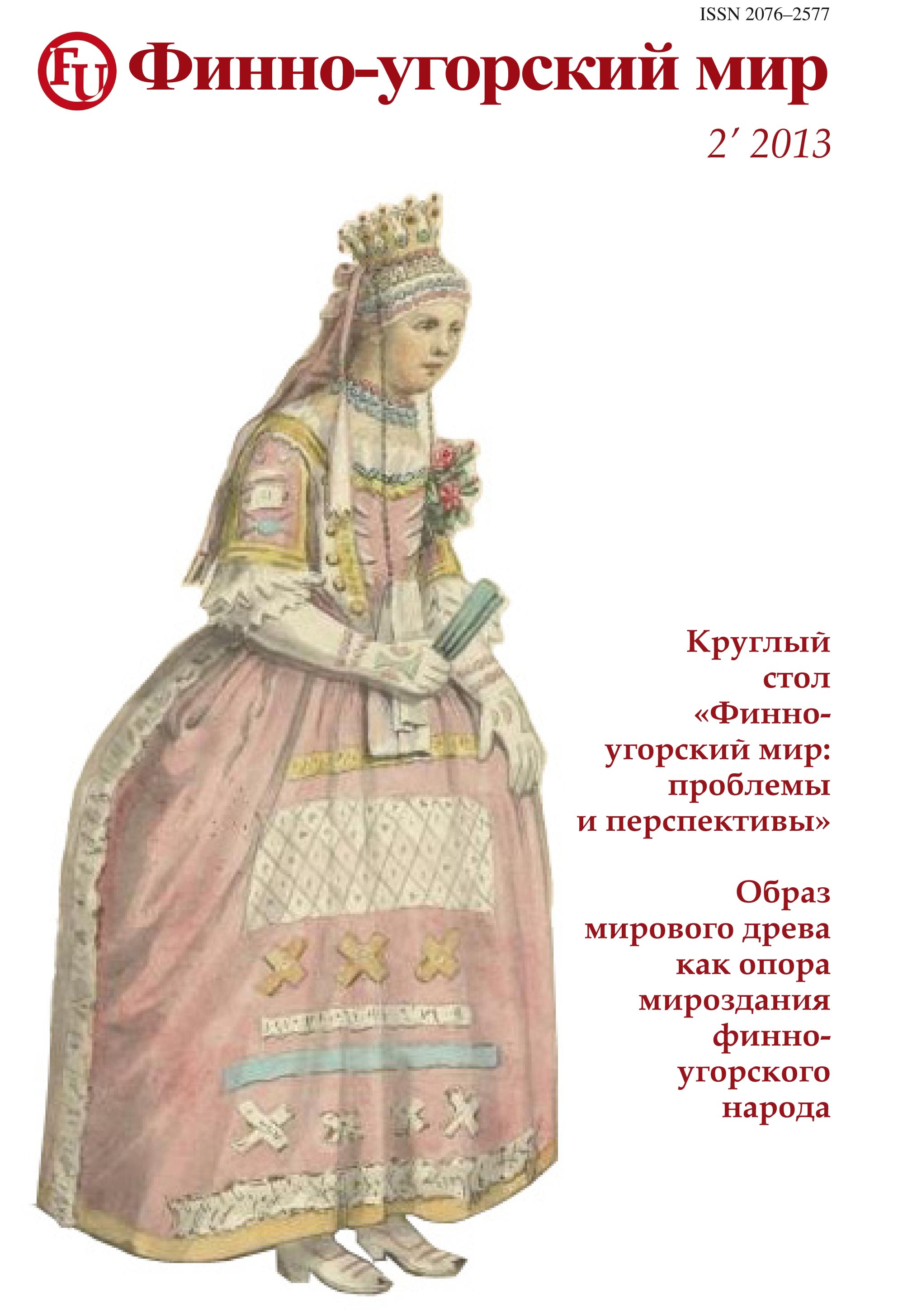
FUM-2013-02 (cover)

CONTENTS

Interview with P. N. TULTAEV, the President of the Association of Finno-Ugric Peoples of the Russian Federation

ROUND TABLE

«Finno-Ugric World: Problems and Perspectives»

Janos PUSZTAY (г. Badacsonytomaj, Hungary). The Situation of the Finno-Ugric Languages: Problems and Perspectives

It studies the topical issues of the development of Finno-Ugric languages and highlights the factors affecting their future: a demographic factor, the weakening of ethnic identity, the proportion of the titular people in the ethnic motherland population. It discusses the problem of the preservation of the languages of Finno-Ugric peoples in Russia.

Keywords: Finno-Ugric languages; Finno-Ugric world; titular nations; ethnic identity; demography.

Emese EGEY (Szombathely, Hungary). Folk Song as the Basis of National Music

It considers the search for the foundations of Hungarian music as an aspect of creativity of Hungarian composers. The article develops the idea of the classification of folk songs and proves the importance of collecting folk material as a condition of preservation of the ethnic identity.

Keywords: folk song; folk music; comparative study; classification of melodies; folklore.

Marta CSEPREGI (Budapest, Hungary). Culture and Language – Points of Interaction

It presents extra-linguistic factors that contribute to the development of the language. It shows some aspects of the research of spiritual culture of the Finno-Ugric peoples of Russia by Finnish and Hungarian scholars, discloses the relationship of language and culture and the need for an interdisciplinary approach in order to identify common patterns in language learning.

Keywords: Finno-Ugric Studies; spiritual traditions; culture; language; interdisciplinarity.

Agnes KEREZSI (Budapest, Hungary). Exhibits of Material Culture of Moksha and Erza in the Finno-Ugric Collection of Antal Reguly

It shows the history of collecting ethnographic material of the Finno-Ugric peoples. The particular attention is paid to the Hungarian scholar Antal Reguly, who collected the earliest exhibits in European collections for the EthnographicMuseum (Budapest, Hungary). It provides the information about the ethnographic material of the Mordovians-Erza and Mordovians-Moksha presented in the Museum.

Keywords: ethnographic museum; ethnography; Finno-Ugric peoples; Moksha; Erza.

A. V. ISHMURATOV (Izhevsk, Russia). Main Activities of the Finno-Ugric Research and Education Center for Humanitarian Technologies of Udmurt State University

It touches upon the issues of training high skilled personnel and the issue of modern technologies for education in rural areas. The article proves the necessity of establishing the conditions for ethnic and cultural education as one of the aspects of increasing national consciousness among the Udmurts.

Keywords: mother tongue; national roots; ethnic and cultural education; Finno-Ugric Studies; integration; innovation; institutionalization.

R. V. KIRILLOVA (Izhevsk, Russia). Zoomorphic Symbolism in the Udmurt Poem by M. P. Petrov «Italmas»

The article tells about the content of the Udmurt poem by M. P. Petrov «Italmas» and explains the zoomorphic symbols: a swan, and a golden eagle.

Keywords: poem; a symbol; Udmurt gentiles; mentality; national form.

G. M. AGEEVA (Saransk, Russia). Booklore in Ethno-cultural Dimension

It studies some aspects of the development of the book culture with the focus made on the ethno-establishing function. It examines the views of national and foreign scholars on the role of booklore in today’s world.

Keywords: booklore; book culture; information sphere; communication; ethnic culture.

O. G. BELOMOEVA (Saransk, Russia). World Outlook as a Condition for Cultural Interaction

It touches upon the importance of the world outlook paradigm in the dialogue of cultures.

Keywords: interaction of cultures; Finno-Ugric peoples; Finno-Ugric world; integration; fragmegration; globalization; localization and glocalization.

T. G. VANTSOVA (Saransk, Russia). E-learning Resources for Solving the Problem of Preservation of National Languages (on the example of the Mordovian languages)

Following the decision of preservation and promotion of the Mordovian languages the author suggests the project to create an information portal “Ethno-linguistic Education in the Republic of Mordovia”. The main advantage of this educational resource is the structural organization of the portal and its information content.

Keywords: national languages; Mordovian (Moksha, Ersa) languages; Mordovian language culture; e-learning resources.

A. A. BULYCHEVA (Saransk, Russia). Social Partnership of the Finno-Ugric World Libraries

It analyzes the social partnership of the libraries of the Republic of Mordovia as an up to date trend which allows to promote its own interests and is an effective factor of rendering high quality information and library services to the public.

Keywords: social partnership; libraries of the Finno-Ugric world; information and library work.

JU. A. ELISEEVA (Saransk, Russia). Common Information Space of Finno-Ugric Universities as a Strategic Development Priority

It conspires the establishment of a common information space of the Finno-Ugric universities as multifunctional communication platform for the mutual implementation of important academic, research and cultural projects.

Keywords: Association of Finno-Ugric Universities; education; science; culture; information space.

A. D. YEREMEEV (Saransk, Russia). The Genesis of Professional Art of Mordovian Ethnic Group in the Russian Cultural Space

The article analyses the evolution of the professional art of Mordovian ethnic group from its origins to the present. It emphasizes the special role of Russian cultural tradition in the establishment and development of professional Mordovian types of creativity, and draws attention to the strengthening of contacts with the artistic culture of the Finno-Ugric world within modern Russian cultural space.

Keywords: professional art; artistic tradition; Mordovian ethnic group; cultural interchange; artistic and aesthetic criteria; folklore.

I. V. KLYUYEVA (Saransk, Russia). Louis Orsetti about Stepan Erzya: Ethnics and Ethics of the Mordovians as the Basis of the Sculptor’s World View

It analyzes the published and unpublished sources about the Mordovian sculptor Stepan Erzya, written by an Argentine journalist Luis Orsetti. It reveals the meaning of “ethno-cultural factor”, the ethno-ethics of the Mordovian people, for the worldview of the sculptor.

Keywords: S. D. Erzya; L. Orsetti; XX century sculpture; “ethno-cultural factor” in the worldview of the sculptor; the ethno-ethics of Mordovian people.

T. V. KOSHMAN (Astana, Kazakhstan). Finno-Ugric Peoples in Kazakhstan: According to 2009 National Census

The article gives the results of the census in the Republic of Kazakhstan, which shows the dynamics of the formation of the Finno-Ugric ethnic groups which has begun in the XIX century.

Keywords: Finno-Ugric ethnic groups; traditional national culture; nation; nationality; processes of ethnic identification.

M. V. LOGINOVA (Saransk, Russia). On the Relationship of Art and Ethnicity

The author shows the evidence of the relationship between the art and ethnic groups. It emphasizes the ethnic function of the art and its role in ensuring the continuity of the spiritual life of the people through the mechanism of artistic tradition.

Keywords: traditional culture; universal human values; the ethnic role of arts; ethnic and artistic integrity; ethnic groups.

E. N. LOMSHINA (Saransk, Russia). Creating a Common Educational Space of the Finno-Ugric Studies: Prospects for Development

The article discusses the problem of creating a common educational space of the Finno-Ugric Studies and gives the characteristic of European and international programs such as Tempus, Jean Monnet, and Erasmus Mundus.

Keywords: academic mobility; master degree; Finno-Ugric Studies; Association of Finno-Ugric Universities.

N. I. UCHAIKINA (Saransk, Russia). International Centers as the Condition for Study and Preservation of National Cultures

It proves the necessity of combining efforts for the research, development and preservation of national (Finno-Ugric) cultures. It defines the role of international academic and research centers in cooperation with the leading scholars of the Finno-Ugric world.

Keywords: international Centre; education; science; Finno-Ugric culture; socio-cultural interaction; intercultural dialogue.

N. A. KHAFIZOVA (Perm, Russia). Potential of Academic and Professional Cultural Elites for Solving the Problems of Identity

The author considers the role of the academic elite in the development of the theoretical level of ethnic consciousness and its methods of operation. It formulates the main tasks in optimizing the potential of culture to enhance ethnic self-esteem. It also defines the modern tasks for the cultural elite of the Finno-Ugric peoples.

Keywords: ethnic identity; professional cultural elite; Finno-Ugric peoples; ethnic identity.

I. N. SHKOLKINA (Saransk, Russia). Concept of Conscience in the Culture of the Mordovians

It studies the introduction of the cultural concept “conscience” in the language and gives a comparative analysis of the sayings (English, Russian, Mordovian) with the meaning of righteous living.

Keywords: folklore; metaphor; conscience; ancient Mordovians; cultural transformation; language.

LANGUAGE PALETTE

YU. G. ANTONOV (Saransk, Russia). Genre and Thematic Originality of Mordovian Comedy of the Second Half of the Twentieth Century

The article researches the motion of the Mordovian comedy genres in the second half of the twentieth century and its thematic diversity. When considering the genre palette of the comedy the emphasis is made on the specifics of dramatic conflict, the originality of the character and the principles of their analysis.

Keywords: mordovia drama; comedy; romantic comedy; satirical comedy; comic character; conflict.

N. A. AGAFONOVA, I. N. RYABOV (Saransk, Russia). Dialectological Atlas as the Result of the Research of Erzya Dialects with the Help of Linguistic Geography Methods

The article covers the issues of creating dialectological atlas of Erzya dialects in the Republic of Mordovia.

Keywords: dialect; linguistic geography; area; mapping; variation of lexical tokens; dialectological atlas.

E. V. NAUMOVA (Saransk, Russia). The Man and the Time in Russian Poetry in Mordovia at the Turn of XX–XXI Centuries (on the works by K. Tangalychev)

The author considers the artistic features of the book of poems “By Heart”, “The Road to Kazan”, “Near-village” of Russian-speaking Mordovian poet K. Tangalychev. The author analyzes the main features of the works and shows their artistic features.

Keywords: book of poems; poem; poetry; creative work; K. Tangalychev; motive; theme; lyrical character; God; poet; existence.

A. YU. MASLOVA, T. I. MOCHALOVA (Saransk, Russia). Ethno-linguistic Representation of Ritual Activities in the Phraseology of the Russian Dialects in the Republic of Mordovia

The paper presents an ethno-linguistic analysis of the ritual activities represented by dialect phraseology of Russian dialects speakers on the territory of Mordovia.

Keywords: dialect phraseology; ritual; ethno-linguistics; linguistic view of the world.

N. M. MOSINA (Saransk, Russia). The Semantic Characteristics and Modes of Expression of Experience and Perception as Predicate Actants of Perception in the Erzya Language

On the material of the Erzya language the article researches semantic and grammatical means of expression of the central arguments of the verbs of perception, sensorial, mental and emotional state that is experience and perception.

Keywords: semantic case; actant; experience and perception; experience predicates; semantics of syntax.

V. F. ROGOZHINA (Saransk, Russia). Functioning of the Phraseology in the Moksha Colloquial Language and Its Semantic Grouping

The article deals with the functioning of the phraseology in Moksha colloquial language, its semantic structure, and distinctive features of phraseological synonyms (stylistic, lexical and grammatical structure of the phraseological synonyms).

Keywords: phraseology; phraseological unit; phraseological synonyms; single and multi-structural phraseological synonyms.

G. S. IVANOVA, I. JA. ZHEBRATKINA (Saransk, Russia). The Morphology of Some Impersonal Pronouns in Pshenevskij Dialect of the Moksha Language

The article discusses the morphological features of the interrogative, relative, indefinite, negative, attributive pronouns in Pshenevskij dialect of the Moksha language, determining their paradigmatic possibilities.

Keywords: Moksha language; dialect; pronoun; morphology; paradigm; case.

E. A. TSYPANOV (Syktyvkar, Russia). Names for Baths in Finno-Ugric Languages

The article analyses linguistic, cultural and historical aspects of the names of traditional to the modern nations steam baths in various Finno-Ugric languages both borrowed from other languages and native.

Keywords: Finno-Ugric languages; historical lexicology; borrowings; native-language tokens to indicate the bath.

OUR SHARED HISTORY

N. V. KIROSOVA (Syktyvkar, Russia). The System of Organization and Holding of Regional Komi Party Conferences (1921–1940)

The article discusses the problems related to the party-building in the Komi Autonomous Region. It emphasizes the issues of the organization and holding of regional conferences: timing, representation of delegates, topicality of the agendas, survey of the participants, etc.

Keywords: history of all-Russian Communist party and all-Soviet Union Communist party; party building; history of the Republic of Komi; Komi regional party conferences; system of organizing and conducting conferences; highest party authority.

TREASURY OF TRADITIONAL CULTURE

I. V. ABDRASHITOVA (Saransk, Russia). The problem of the hermeneutic analysis of fairy tales (on the example of Mordovian tales “Harvest in winter”, “Unfinished bast shoe”, “Hot sled”)

It offers a constructive approach to the interpretation of the text on the example of Mordovian popular fairy tales “Harvest in winter”, “Unfinished bast shoe”, “Hot sled”, as well as the way out for the hermeneutic circle with the help of proverbs and illustrations on the one hand, and the search for ethical reasons on the other hand; it emphasizes the positive synthesis of ethical and exemplary interpretations.

Keywords: interpretation; illustration; Mordovian popular fairy tales; hermeneutical circle; ethnicity.

E. N. ANTIPKINA, T. V. KLYUKINA, T. N. SIDORKINA (Saransk, Russia). Commercialization of the Results of Fundamental and Applied Research in Finno-Ugric Culture

The article discusses the features of the implementation of the results of fundamental and applied research in Finno-Ugric Studies conducted at the Institute of National Culture of N. P. Ogarev Mordovia State University for the real sector of the economy.

Keywords: National Research University; Development Programme; commercialization of work; Finno-Ugric culture; “Mordovian farmstead”.

L. E. KORSAKOVA (Cheboksary, Russia). Religious Focus of the Finno-Ugric Ethnic and Cultural Mentality

In the article the author addresses the religion as one of the dominant of Finno-Ugric mentality and considers the structure of religious beliefs of ethnic groups on the examples of Mordovian and Mari culture.

Keywords: Finno-Ugric ethnic and cultural mentality; religion; mythology; Orthodoxy.

N. V. RYABOV (Saransk, Russia). The Image of the World Tree as the Pillar of the Universe for the Finno-Ugric People

The article discusses a variety of cultural and historical variants of the world tree in Finno-Ugric culture. It gives a comparative analysis of the universality of the concept of the world since ancient times.

Keywords: World Tree; the world axis; ancient mythology; cosmogony of Mordovia ethnic group; habitat of our ancestors.

L. V. SAVUSHKINA (Saransk, Russia). The Problem of Cross-Cultural Communication in the Modern Humanities

The article discusses the problems of cross-cultural communication, which is regarded by the author as the communication of the representatives of different cultures speaking different languages.

Keywords: cross-cultural communication; Finno-Ugric world; language; interdisciplinary; cultural dialogue; cultural identity.

FINNO-UGRIC PEOPLES IN CHANGING WORLD

S. P. BURLANKOV, I. V. ZAHVATOVA (Saransk, Russia). Modern Russian Tourist Market and the Prospects for its Development in Mordovia

The defines of the concept of “tourism”, describes the dynamics of the development of international tourism in the last decade and characterizes the place of Russia at the global tourist market.

Keywords: tourism; the development of tourism in the world, Russia and Mordovia; tourist activity; tourist arrivals.

N. P. MAKARKIN, V. V. MITROKHIN (Saransk, Russia). Funding of Energy Efficiency Projects: Opportunities for Mordovia

The article researches the problems of financing projects related to improving energy efficiency of regional businesses and organizations and considers the scenarios of borrowed funding of energy saving measures.

Keywords: tenergy efficiency; energy saving; borrowed funding; regional banks; investment projects; leasing; factoring; project financing.

S. G. BUSALOVA, S. M. MAKEYKINA, R. I. PANKOVA (Saransk, Russia). Topical Issues of Financial Security of National Policy in Ethno-Cultural Development of the Finno-Ugric Society

It analyses modern trends of improving socio-economic conditions of the Finno-Ugric peoples, including the significant change in the financial support for the state national policy in the sphere of their ethnic and cultural development.

Keywords: financial security; national policy; ethnic and cultural development; Finno-Ugric society; ethnic factor; ethno-national territory; management of the national processes; economic sustainability of ethnic groups.

Posted in 2013, Archives, № 2 (15) | Tagged , | Comments Off on Contents (2013, 2)

Our authors (2013, 1)

Bataykina Irina N.,
Post-graduate student, Department of Journalism, N. P. Ogarev Mordovia State University (Saransk, Russia), bataikina_irina@mail.ru

Belyaeva Tatyana N.,
Head of the laboratory “Mari School”, Institute of Finno-Ugric Studies, Mari State University (Yoshkar-Ola, Russia), beljaeva1978@rambler.ru

Behtereva Lyudmila N.,
Doctor of Historical Sciences, leading research fellow, Department of Historical Research, Udmurt Institute of History, Language and Literature, Ural Branch of the Russian Academy of Sciences (Izhevsk, Russia), behterevaln@yandex.ru

Boyarinova Galina N.,
Cand. Sc. {Philology}, Docent, Department of Finno-Ugric Literature and Folklore, Mari State University (Yoshkar-Ola, Russia), +78362468939

Vaganova Elena N.,
Cand. Sc. {Philology}, Docent, Department of Foreign Languages for Science and Engineering, N. P. Ogarev Mordovia State University (Saransk, Russia), waganowa@mail.ru

Gerasimova Dina V.,
Cand. Sc. {Philology}, Professor, Department of Philology, Ugra State University (Khanty-Mansiysk, Russia), gerasimova142@yandex.ru

Grishunina Valentina P.,
Cand. Sc. {Philology}, Docent, Department of Erzya Language, N. P. Ogarev Mordovia State University (Saransk, Russia), grishuninavalentina@rambler.ru

Ephimisch Nadezhda M.,
President of the Uralic peoples Union in Ukraine (Kiev, Ukraine), komi@ua.fm

Zhulina Marina A.,
Cand. Sc. {Geography}, Docent, Head of Department of International and Regional Tourism, N. P. Ogarev State University (Saransk, Russia), mzhulina@mail.ru

Kochevatkin Alexander M.,
Cand. Sc. {Philology}, Docent, Department of Moksha Language N. P. Ogarev Mordovia State University (Saransk, Russia), alekoch@mail.ru

Kubantseva Irina A.,
Cand. Sc. {History}, Docent, Department of Library and Information Resources, N. P. Ogarev Mordovia State University (Saransk, Russia), kubancevair@rambler.ru

Levina Maria Z.,
Cand. Sc. {Philology}, Docent, Department of Erzya Language, N. P. Ogarev Mordovia State University (Saransk, Russia), lev.mariya@mail.ru

Losev Pavel N.,
Graduate student, Major “Socio-cultural service and tourism”, N. P. Ogarev State University (Saransk, Russia), lpn1990@mail.ru

Martynchuk Tatiana A.,
Training specialist, teacher, I. A. Kuratov Syktyvkar Humanities and Education College (Syktyvkar, Russia), martynchukt@mail.ru

Mokshina Elena N.,
Doctor of History, Professor, Chair of Pre-revolutionary Russian History, Archeology and Ethnography, N. P. Ogarev Mordovia State University (Saransk, Russia), kaf_dor@mail.ru

Naumkin Trifon V.,
Post-graduate student, Department of Economics and Logistics, N. P. Ogarev State University (Saransk, Russia), stigmatych@yandex.ru

Nekrasov Ruslan V.,
Senior Lecturer, Department of Design, Syktyvkar State University (Syktyvkar, Russia), kebrarus78@yandex.ru

Nesterova Nina A.,
Cand. Sc. {History}, Rector of the Komi Republic Academy of Public Service and Administration (Syktyvkar, Russia), rectorat@krags.ru

Pchelovodova Irina V.,
Cand. Sc. {Philology}, research fellow, Udmurt Institute of History, Language and the Literature, Ural Branch of the Russian Academy of Sciences (Izhevsk, Russia), pchelka-irina@mail.ru

Radzetskaya Olga V.,
Cand. Sc. {Cultural Studies}, Docent, Maimonides State Classical Academy (Moscow, Russia), olgabreman@yandex.ru

Rakin Anatoly N.,
Doctor of Philology, Chairperson of the Committee of Finno-Ugric Studies of the Russian Federation (Syktyvkar, Russia), anatolij.rakin@mail.ru

Fedyuneva Galina V.,
Doctor of Philology, senior research fellow, Institute of Language, Literature and History, Komi Scientific Center, Ural Branch of the Russian Academy of Sciences (Syktyvkar, Russia), gfedyuneva@mail.ru

Furmanova Valentina P.,
Doctor of Education, Professor, German Philology Department, N. P. Ogarev State University (Saransk, Russia), vpfurman@mail.ru

Tsypkaykina Valentina P.,
Cand. Sc. {Philology}, Docent, Erzya Language Department, N. P. Ogarev Mordovia State University (Saransk, Russia), tsypkaikina@gmail.com

Yuzykayn Tatyana V.,
Fellow applicant, Sector of National History, Institute of Language, Literature and History, Komi Scientific Center, Ural Branch of the Russian Academy of Sciences (Syktyvkar, Russia), tatyana_juzykain@mail.ru
Yakovleva Galina A.,
Specialist in teaching and studies, Department of Journalism, Mari State University (Yoshkar-Ola, Russia), galjak_73@mail.ru

Posted in 2013, Archives, № 1 (14) | Tagged , | Comments Off on Our authors (2013, 1)

Contents (2013, 1)

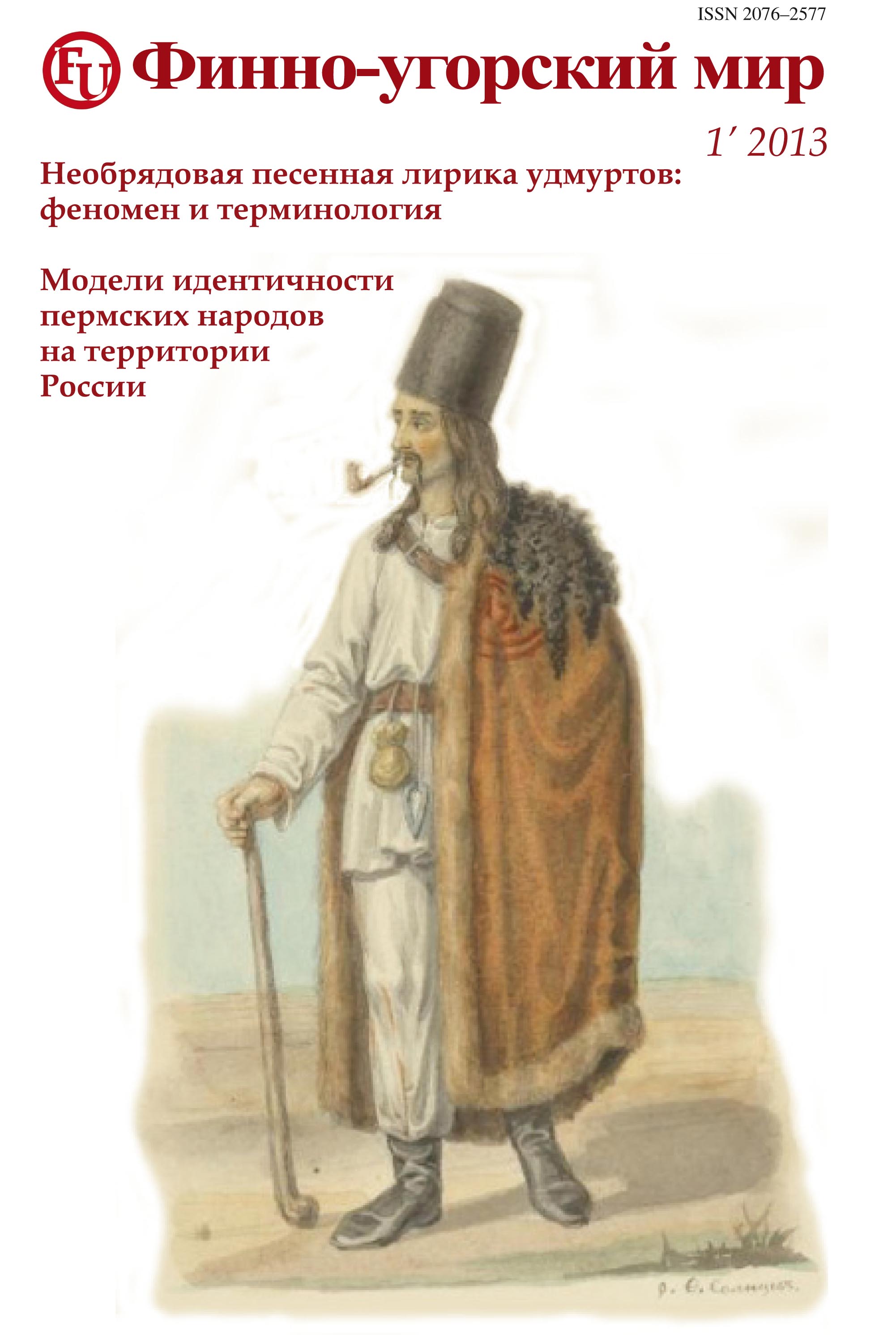
FUM-2013-01 (cover)

 LANGUAGE PALETTE

G. V. FEDYUNEVA (Syktyvkar, Russia). Vocabulary of Komi dialect in the context of the Bulgar-Permian linguistic relations

The article discusses the new Komi-Chuvash correspondences indicating long-term contacts of ethnic groups of Vychegodskaya Perm with Volga Bulgars.

Keywords: Bulgar-Permian communication; contact lexicon.

A. M. KOCHEVATKIN (Saransk, Russia). Anatomical terminology in the Erzya Language

On the example of the Erzya language it investigates the problem of creating anatomical terminology on the basis of Finno-Ugric languages.

Keywords: anatomy, osteology, arthrology, myology, splanchnology vocabulary.

M. Z. LEVINA, V. P. GRISHUNINA (Saransk, Russia). Dialectal variation of the phytonym “Dog Rose” in the Moksha language

It touches upon the problems of distribution and origin of the word meaning “dog rose” in the dialects of the Moksha language. The dog rose grows everywhere in Mordovia and there are many lexical tokens to denote it.

Keywords: dialects and sub-dialects of the Moksha language; areal distribution, dog rose lexis; distribution of the phytonym; lexical token; nomination principles; etymology of words.

I. V. PCHELOVODOVA (Izhevsk, Russia). Non-ritual song lyrics of the Udmurts: phenomenon and terminology

The article considers archaic and recent genres of non-ritual folk music and songs coexisting in the Udmurt tradition. The author employs the analysis of the terms defining these genres, which allows to understand the essence of the Udmurt folklore lyrical tradition.

Keywords: Udmurt non-ritual lyrical songs; non-ritual improvisation songs; diachrony of style layers; non-ritual terms of song lyrics in the Udmurt folklore.

T. N. BELYAEVA (Yoshkar-Ola, Russia). The poetics of drama by V. Abukaev-Emgak

It shows the functional specificity of artistic details and symbolic images in the drama of Mari writer V. Abukaev-Emgak.

Keywords: Mari drama; V. Abukaev-Emgak; artistic details; symbolic images.

G. N. BOYARINOVA (Yoshkar-Ola, Russia). Artistic features of the drama by Yu. Baiguzov

The article studies the poetics in the drama of Mari writer Yu. Baiguzov. Considering the stylistics of parables, the author characterizes the genre specifications of the plays: “Silk Swing” and “Dawn of the Abyss”. Much attention is paid to national symbols, originality of the remarks and the language of the characters.

Keywords: Mari dramaturgy; poetics; genre specificity; symbolism; language of the characters.

G. A. YAKOVLEVA (Yoshkar-Ola, Russia). Creative personality of Mari play-writer Mikhail Rybakov

The article discusses the artistic personality of a well-known Mari play-writer Mikhail Rybakov. The author was concerned with ethical and moral qualities of his contemporaries, looked for new techniques and tools to achieve his goal. He is the author of many genres in Mari drama.

Keywords: creativity; Mari drama; dramaturgy; comedy; genre; dramatic effect.

I. N. BATAYKINA (Saransk, Russia). Instrumental role of the press for the national revival of the Finno-Ugric ethnic group

The article discusses ethnic journalism as a professional activity for the interaction of journalism as an institution and the system of national relations.

Keywords: Finno-Ugric peoples; national culture; ethnic journalism ; mass media; instrumental functions of mass media; the regional press; the media space.

V. P. TSYPKAYKINA (Saransk, Russia). Specific features of object forms of the present-future tense in the Mordovian languages

The article discusses the features of object forms of the present-future tense in the modern Mordovian languages.

Keywords: Mordovian (Erza and Moksha) languages; meaning; forms of the present-future tenses; non-object and object conjugations. 

OUR SHARED HISTORY

I. A. KUBANTSEVA (Saransk, Russia). Organization of national publishing for the peoples of the Volga region (October 1917-1929)

The article deals with the organization of national publishing during the period from October 1917 to 1929. It shows the formation of the publishing system for the Mordovians and other peoples of the Volga region. Particular attention is paid to the activities of the Central and East Central Publishing Houses of the USSR for the production of literature in the Mordovian (Moksha and Erzya) language.

Keywords: Publishing; printing; national book publishing; textbook; original manuscript; circulation.

T. A. MARTYNCHUK (Syktyvkar, Russia). The contribution of V. A. Bogoslovskaja in the system of pre-school education in Komi ASSR

On the example of the many-sided activities of V. A. Bogoslovskaja, the founder of the first kindergarten in the Komi Republic, the article examines the history of the establishment of the network of preschool institutions in the Komi Republic in the 1920-s. The particular attention is paid to the contribution of a teacher into the organization of pre-school education management in the region, creation and improvement of the educational system and academic work with children, and the training of teachers for pre-school institutions.

Keywords: pre-school education; parenting; kindergarten; Komi ASSR, V. A. Bogoslovskaja.

T. V. YUZYKAYN (Syktyvkar, Russia). Formation and development of the cooperation of Finno-Ugric youth in culture, education and science at the end of XX – beginning of XXI century

It traces the emergence and development of Finno-Ugric youth cooperation, some of which later became independent and integral parts of the Finno-Ugric cooperation.

Keywords: Finno-Ugric peoples; MAFUN; Finno-Ugric youth movement; ethno-futurism; International meeting of Finno-Ugric high school pupils, International Association of Finno-Ugric Universities.

TREASURY OF TRADITIONAL CULTURE

L. N. BEHTEREVA (Izhevsk, Russia). The Udmurts in urban surrounding: festive culture in the system of adaptation to the conditions of the NEP (New Economic Policy)

Basing on new archival sources and published materials the article considers festive culture as one of the mechanisms of the adaptation of the Udmurts to the urban environment in the 1920-s.

Keywords: Udmurts; festive culture; adaptation; NEP.

O. V. RADZETSKAYA (Moscow, Russia). Musical projection of the cultural dialogue between East and West in the context of the Volga-Ural civilization

The article considers the musical projection of cultural dialogue between East and West in the context of the ongoing and mutual influence. This convention is a clear motivation to define creative realities in the development of musical culture and it provides the key to the understanding of its original ethnic nature.

Keywords: Volga-Ural civilization; ethnic culture; Finno-Ugric music world.

V. P. FURMANOVA (Saransk, Russia). Intercultural communication and the problem of integration to European culture

The article raises the problem of the study of intercultural communication and shows some ways to solve it within the framework of the international academic and research seminar “Intercultural communication and development of identity of the Finno-Ugric world. Foreign languages as a means of integration into the European culture”.

Keywords: intercultural communication; language; culture; mentality; stereotype; cultural background knowledge.

D. V. GERASIMOVA (Khanty-Mansiysk, Russia). Pantheon of Mansi deities

The author examines the pantheon of Mansi deities in the context of the mythological heritage and sacred outlook of Ob-Ugrian peoples.

Keywords: Dimensional and sculptural decorative features of Sysolsk spinning wheels of the second half of XIX – early XX century.

R. V. NEKRASOV (Syktyvkar, Russia). Dimensional and sculptural decorative features of Sysolsk spinning wheels of the second half of XIX early XX century

The article examines dimensional, sculptural, artistic and aesthetic aspects of the spinning wheels of Sysolsk type. It makes the hypothesis of the influence of the neighboring ethnic groups for the formation of the stylistic features of Sysolsk spinning wheel.

Keywords: spinning wheel; design; shape, decoration technique; canon; tradition.

E. N. VAGANOVA (Saransk, Russia). The cult of the moon in the religious beliefs of Mordovian nation

Considering folklore and ethnographic sources the articles studies the worship to the moon which existed in ancient times among the Mordovians. For the first time it reconstructs religious and philosophical foundations of this worship. For academic purposes the article introduces new facts about the ethnic culture of the nation.

Keywords: astral symbols; new moon; the god of the moon; chronology; moon worship.

 FINNO-UGRIC PEOPLES IN CHANGING WORLD

T. V. NAUMKIN (Saransk, Russia). Fiscal policy and economic self-sufficiency of the Finno-Ugric republics (on the example of the Republic of Mordovia, and the Republic of Mari El)

The article discusses the need for the mechanism and ways of their improvement for the formation of economic self-sufficiency of the territories, basing on the transfer of the powers in the area of fiscal policy on the sub-federal level.

Keywords: economic self-sufficiency; fiscal policy; tax rate; tax incentives; gross regional product; investment.

N. M. EPHIMISCH (Kiev, Ukraine). Two identity models of the Permian peoples in Russia in the context of the political process (end of XIX beginning of the XXI century)

The article studies of ethno-political processes in the Finno-Ugric regions of Russia in the XIX – XXI centuries. Analyzing the trial cases (“Multan case”, “SOFIN case”) it presents two identity models in the Republic of Komi and Udmurtia. To understand the traditions of compromise in Komi culture, which contributed to the ethnic revival in the 1990s it analyzed the legacy of the philosopher K. Zhakov.

Keywords: Finno-Ugric regions; “Multan case”; “SOFIN case”; Permian peoples; identity.

M. A. ZHULINA, P. N. LOSEV (Saransk, Russia). Tourism in Finno-Ugric countries: a comparative analysis

It makes the comparative evaluation of three Finno-Ugric countries – Finland, Hungary and Estonia at the global tourism market according to the method proposed by the World Economic Forum. It identifies the priority areas in tourism in each of the countries and defines the problems and prospects of development.

Keywords: tourism; Finno-Ugric area; types of tourism; tourist infrastructure; Finland; Hungary; Estonia.

 EVENTS, PEOPLE, BOOKS

N. A. NESTEROVA (Syktyvkar, Russia). Komi Republic Academy of Public Administration: developing Finno-Ugric cooperation and international mobility

A. N. RAKIN (Syktyvkar, Russia). Oulu – a meeting place of the Finno-Ugric scholars from all continents in 2015

E. N. MOKSHINA (Saransk, Russia). Dukhobors and Canada: history and modernity: Review of the monograph

Posted in 2013, Archives, № 1 (14) | Tagged , | Comments Off on Contents (2013, 1)

Our authors (2012, 3/4)

Tultaev Peter N.,
Chairman of the Council of Russian Civil Movement “Association of Finno-Ugric Peoples of the Russian Federation” (Saransk, Russia), afunrf@yandex.ru

Pusztay János,
Doctor of Philology, Professor, Director of the Collegium Fenno-Ugricum, Head of the Department of the Ural Philology, University of West Hungary (Szombathely, Hungary), janos_pusztay@hotmail.com

Makarkin Nikolai P.,
Doctor of Economy, Professor, the President of Mordovia N. P. Ogarev State University (Saransk, Russia), makarkin@mrsu.ru

Tsypanov Evgeny A.,
Doctor of Philology, Professor, Head of Linguistic Sector, Institute of Languages, Literature and History, Komi Academic and ResearchCenter, Ural Branch of Russian Academy of Science (Syktyvkar, Russia), tsypanov@mail.illhkomisc.ru

Mosin Mikhail V.,
Doctor of Philology, Professor, Head of Chair of Finno-Ugric and Comparative Philology, N.P.OgarevMordoviaStateUniversity (Saransk, Russia), +7 8342 476087

Mishanin Yuri A.,
Chief-Editor of “Finno-Ugric Newspaper”, Doctor of Philology, Professor (Saransk, Russia), fucenter60@mail.ru

Mishanina Anastasia Yu.,
Post-graduate Student, Russian Academy of National Economy and Civil Service under the President of Russian Federation (Moscow, Russia), fucenter60@mail.ru

Potapov Pavel F.,
Doctor of Philology, Professor, Head of Chair of Journalism, N. P. Ogarev Mordovia State University (Saransk, Russia), p_f_potapov@mail.ru

Vidyaeva Anastasia V.,
Post-graduate Student, Chair of Journalism, N.P.OgarevMordoviaStateUniversity (Saransk, Russia), anastasiyavidyaeva@rambler.ru

Rakin Anatoly N.,
Doctor of Philology, Professor, Senior Research Fellow, Institute of Languages, Literature and History, Komi Academic and ResearchCenter, Ural Branch of Russian Academy of Science (Syktyvkar, Russia), anatolij.rakin@mail.ru

Kazantseva Tatiana M.,
Fellow of Inter-Regional Research Centre of Finno-Ugric Studies, N.P.OgarevMordoviaStateUniversity (Saransk, Russia), tatyzgina@mail.ru

Chemyshev Andrey V.,
Software Engineer, Center for Innovative Language Technology, Komi Republican Academy of Public Administration and Management, Laureate of the State Prize of the Republic of Mari El (Syktyvkar, Russia), chemyshev.andrey@gmail.com

Gavrilova Valentina G.,
Cand. Sc. {Philology}, Docent, Chair of General and Finno-Ugric Linguistics, Institute of Finno-Ugric Studies, MariStateUniversity (Yoshkar-Ola, Russia), valgavrilova@rambler.ru

Boyarinova Galina N.,
Cand. Sc. {Philology}, Docent, Chair of Finno-Ugric Literature and Folklore, Institute of Finno-Ugric Studies, MariStateUniversity (Yoshkar-Ola, Russia), +7 836 246 8939

Mikhailov Vitaly T.,
Cand. Sc. {Pedagogics}, Docent, Chair of Finno-Ugric Literature and Folklore, MariStateUniversity (Yoshkar-Ola, Russia), vitatim@yandex.ru

Fedotova-Gradobaeva Irina G.,
Student, Institute of Finno-Ugric Studies, MariStateUniversity (Yoshkar-Ola, Russia), gradobaeva-fedotova2011@yandex.ru

Belyaeva Tatyana N.,
Head of the Laboratory “MariSchool”, Institute of Finno-Ugric Studies, MariStateUniversity (Yoshkar-Ola, Russia), beljaeva1978@rambler.ru

Sheyanova Svetlana V.,
Cand. Sc. {Philology}, Docent, Chair of Finno-Ugric Literature, N. P. Ogarev Mordovia State University (Saransk, Russia), sheyanovas@mail.ru

Tsygankin Dmitry V.,
Doctor of Philology, Professor, Chair of Finno-Ugric and Comparative Philology, N.P.OgarevMordoviaStateUniversity (Saransk, Russia), +7 8342 476087

Ryabinina Marianna V.,
Post-graduate Student, Chair of Finno-Ugric Literature and Folklore, Mari State University (Yoshkar-Ola, Russia), mari.riabinina@yandex.ru

Kornishina Galina A.,
Doctor of History, Professor, Chair of Contemporary History of the Peoples of Russia, N.P.OgarevMordoviaStateUniversity (Saransk, Russia), kornihina@rambler.ru

Mokshina Elena N.,
Doctor of History, Professor, Chair of Pre-revolutionary Russian History, Archeology and Ethnography, N.P.OgarevMordoviaState university (Saransk, Russia), kaf_dor@mail.ru

Svyatogorova Barbara S.,
Cand. Sc. {Cultural Studies}, Docent, Chair of Cultural Studies, Ethnic Culture and Dramatic Arts, Institute of National Culture, N.P. Ogarev Mordovia State University (Saransk, Russia), mikargina@mail.ru

Bahlov Igor V.,
Doctor of Political Science, Head of Academic and ResearchCenter «Political Analysis of Territorial Systems», N.P.OgarevMordoviaStateUniversity (Saransk, Russia), bahlov@mail.ru

Kurlevsky Ivan V.,
Lecturer, Chair of State and Law Disciplines, Middle Volga Branch of Russian Law Academy of the Ministry of Justice of Russia (Saransk, Russia), kyrlevskii@mail.ru

Kuzivanova Olga Yu.,
Cand. Sc. {History}, Docent, Komi Republican Academy of Public Administration and Management (Syktyvkar, Russia), kuzivanova@krags.ru

Mitrokhin Vladimir V.,
Cand. Sc. {Economics}, Head of the Chair of Finance and Credit, N. P. Ogarev Mordovia State University (Saransk, Russia),
mitrokhin_vlad@mail.ru

Simaeva Ilmira K.,
Post-graduate Student, Chair of Finance and Credit, N.P.OgarevMordoviaStateUniversity (Saransk, Russia), i.simaewa@yandex.ru

Busalova Svetlana G.,
Cand. Sc. {Economics}, Docent, Chair of Finance and Credit, N.P.OgarevMordoviaStateUniversity (Saransk, Russia), sbusalova@yandex.ru

Makeykina Svetlana M.,
Cand. Sc. {Economics}, Docent, Chair of Finance and Credit, N.P.OgarevMordoviaStateUniversity (Saransk, Russia), makeikinasm@yandex.ru

Pankova Rimma I.,
Lecturer, Chair of Finance and Credit, N.P.OgarevMordoviaStateUniversity (Saransk, Russia), +7 8342 290782

Shabykov Vitaly I.,
Cand. Sc. {Philosophy}, Senior Research Fellow, Department of Sociology, Mari V. M. Vasilyev Research Institute of Language, Literature and History (Yoshkar-Ola, Russia), kudsebs@rambler.ru

Solovyev Victor S.,
Doctor of Philosophy, Professor, Chair of Theory and History of State and Law, Mari State University, Director of the Small Academy of Public Administration in the Republic of Mari El (Yoshkar-Ola, Russia), +7 8362 425520

Romanova Olga N.,
Cand. Sc. {Psychology}, Docent, Chair of Social Psychology, N. P. Ogarev Mordovia State University (Saransk, Russia), famylypost@mail.ru

Romanov Daniil K.,
Post-graduate Student, Chair of Social Psychology, N.P.OgarevMordoviaState university (Saransk, Russia), famylypost@mail.ru

Homjakov Evgenij A.,
Student of Foreign Languages Faculty, N.P.OgarevMordoviaState university (Saransk, Russia), ego-kvanton@mail.ru

Abramov Vladimir K.,
Doctor of History, Professor, Chair of Contemporary History of the Peoples of Russia, N.P.OgarevMordoviaStateUniversity (Saransk, Russia), abramovvk@mail.ru

Tanaseichuk Andrey B.,
Doctor of Cultural Studies, Professor, Chair of Russian and Foreign Literature, N.P.OgarevMordoviaStateUniversity (Saransk, Russia), andtanaseichuk@mail.ru

Posted in 2012, Archives, № 3/4 (12/13) | Tagged , | Comments Off on Our authors (2012, 3/4)

Contents (2012, 3/4)

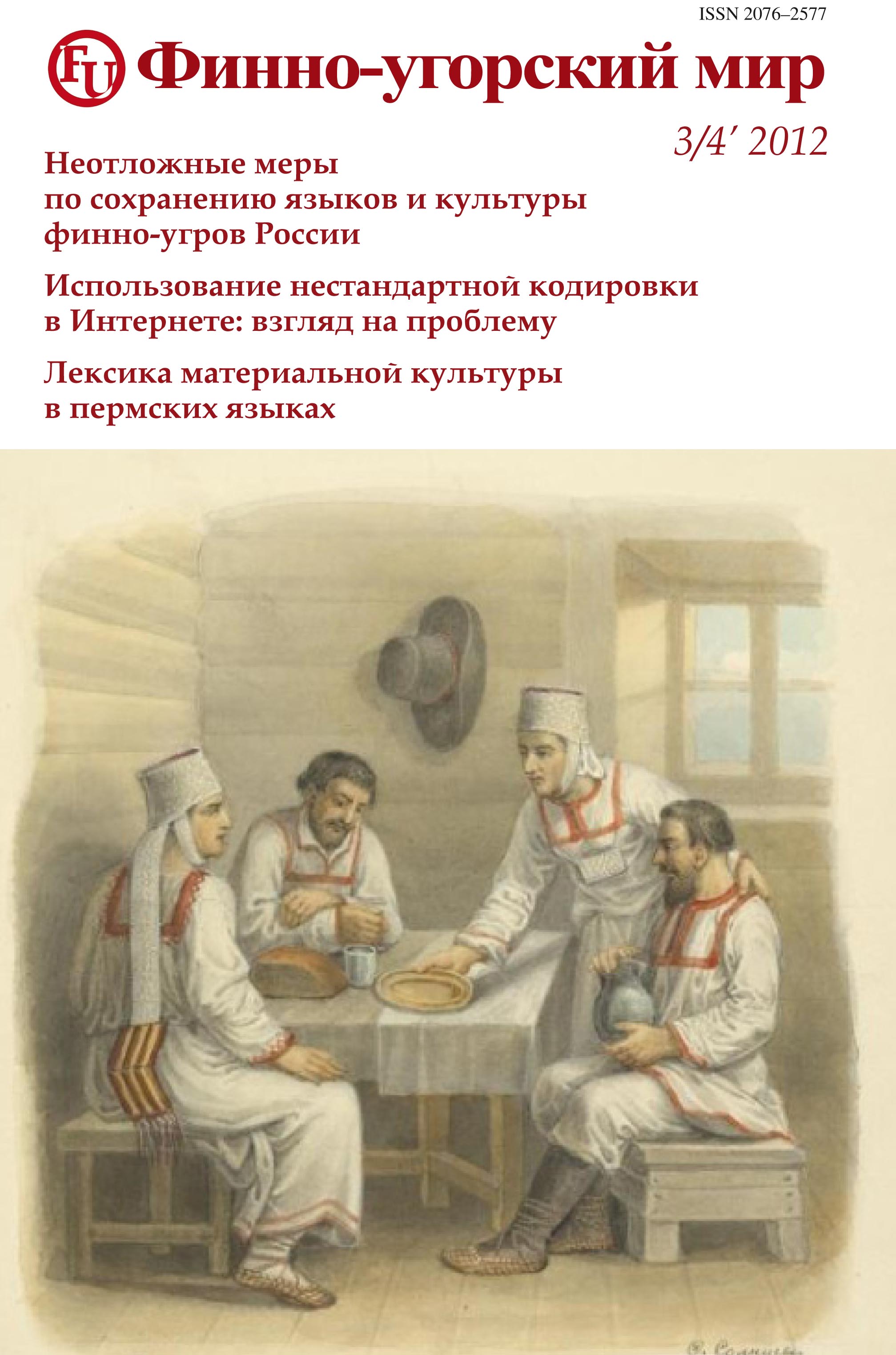
FUM-2012-3-4 (cover)

CONTENTS

 P. N. TULTAEV (Saransk, Russia). Chairman of the Council of Russian Civil Movement “Association of Finno-Ugric Peoples of the Russian Federation”

Resolution of VI World Congress of Finno-Ugric Peoples

J. PUSZTAY (Szombathely, Hungary). Improving the culture and education – saving the nation

The article refers to a complex situation with the language and culture of Finno-Ugric peoples, especially Hungarians, and considers a number of measures promoting the preservation of national identity.

Keywords: VI World Congress of Finno-Ugric peoples; Collegium Fenno-Ugricum; Finno-Ugric peoples; language support; the preservation of the nation.

N. P. MAKARKIN (Saransk, Russia). Urgent Measures to Preserve the Languages and Cultures of the Finno-Ugric Peoples in Russia

E. A. TSYPANOV (Syktyvkar, Russia). Keeping the Aims from Congress to Congress (on the 20th anniversary of the World Congress of Finno-Ugric peoples)

It considers the phenomenon of World Congress of Finno-Ugric peoples, presents a brief information about its organization and carrying, as well as makes at attempt to measure its value mostly for the life of the Finno-Ugric peoples living in Russia.

Keywords: ethnopolitics; ural peoples; World Congress of Finno-Ugric Peoples.

 LANGUAGE PALETTE

M. V. MOSIN (Saransk, Russia). Modern Languages of the Finno-Ugric Peoples of Russia (current situation and possible development of the Mordovian languages)

It analyses the current situation with the Mordovian languages and their functioning in various spheres of public life, preschool, comprehensive and vocational education. Special attention is paid to the analysis of the learning the Moksha and Erzya languages in secondary comprehensive schools.

Keywords: bilingualism; congress; education; Finno-Ugric peoples; languages.

YU. A. MISHANIN, A. YU. MISHANINA (Saransk, Russia). National Press in Market Conditions: Losses and Gains (in Finno-Ugric сontext)

The article reveals the specific features of ethnic mass media in the new market environment, analyzes the economy of the national press and proves the necessity of broadening the use of the Finno-Ugric languages in the mass media.

Keywords: information space of the Finno-Ugric peoples; economics of the press; Internet technology; journalistic education.

P. F. POTAPOV, A. V. VIDYAEVA (Saransk, Russia). Political Repressions of the 30th XX century in Mordovia Newspapers

On the example of the modern Mordovian newspapers the article shows the role of mass media in touching the issue of political repressions of 1930th.

Keywords: political repression; “Zarja”; “Vpered”; “Sel’skie vesti”; GULAG; “Pobeda”; “Insarskij vestnik”.

A. N. RAKIN (Syktyvkar, Russia). Vocabulary of Material Culture in the Permic Languages

The article represents the first experience of the research of material culture vocabulary in three closely related languages: Komi-Zyryansky, Komi-Permyak and Udmurt. The author considers a system of food vocabulary symbols in diachronic and synchronic aspects.

Keywords: material culture; Permic languages; vocabulary; naming of food.

T. M. KAZANTSEVA (Saransk, Russia). Original Features in Artistic Interpretation of the Image of Erzya in the Works of Mordovian Poets

The article touches upon the works of Mordovian poets, dedicated to the famous sculptor Stepan Erzya. It makes an attempt to give an objective analysis of the works, which have not been previously analyzed in this area and identifies the common features in the perception of the phenomenon of Erzya by his countrymen.

Keywords: Mordovian poetry; legacy of S. Erzya; author’s perception; national identity.

A. V. CHEMYSHEV (Syktyvkar, Russia). Use of Improper Character Encoding: Considering the Problem

The article deals with a variety of non-standard fonts with “obsolete” character encoding used of by the national newspapers, magazines, publishers and the consequences of such use.

Keywords: information civilization; font; encoding; national alphabet; Unicode.

V. G. GAVRILOVA (Yoshkar-Ola, Russia). Dubbing as a Manifestation of Code-Switching

The article describes the dubbing of certain words and grammatical indices in oral discourse of the Mari and Russian language.

Keywords: bilingualism; code-switching; duplication; Mari language; Russian language.

G. N. BOYARINOVA (Yoshkar-Ola, Russia). Styles and Genre Variety of Mari Drama

The article researches the main styles and genres of Mari drama. It defines two main styles: realistic and lyrical-romantic.

Keywords: Folk traditions; character; conflict; stylistic direction; genre; philosophical concept.

V. T. MIKHAILOV (Yoshkar-Ola, Russia). Evolution of National Mari Textbooks during Soviet Period: History, Theory, Practice

It analysis the ongoing development of national Mari textbooks during the Soviet period (1917th – end of 1980th), shows thier conceptual basics and proves the need for continuity of the positive experience in the development of modern textbooks for national schools.

Keywords: textbooks; the policy and concept of national education.

T. N. BELYAEVA , I. G. FEDOTOVA-GRADOBAEVA (Yoshkar-Ola, Russia). Lyrical Genres of Poetry by Zoya Dudina

The article identifies the system of genres and artistic features in the poetry of Mari author Zoya Dudina.

Keywords: Mari poetry; Zoya Dudina; lyrical genres; genre identity.

S. V. SHEYANOVA (Saransk, Russia). Mordovia Novel of Our Time: National Artistic Traditionalism and Features of the Updated Epic Form

The article considers the national epic traditions and innovative features in Mordovia novels about modernity.

Keywords: novel about the modernity; national traditionalism; updated traditions; innovative features; literary trend.

D. V. TSYGANKIN (Saransk, Russia). Nominative Derivatives in Industrial Terminology in the Mordovian languages

The article considers the nominatives, lexicalized phrases, in the context of semantic relations of their components.

Keywords: nominative; lexicalized phrase; regularity; optimality.

M. V. RYABININA (Yoshkar-Ola, Russia). Indirect Form of Mental Imaging in the Story “Orphaned Soul” by G. Alexeyev

The article considers the portrait, landscape and interior in the story of Mari writer G. Alexeyev “Orphaned Soul” as the methods of indirect visualization of psychological images.

Keywords: Mari story; indirect form of mental images; landscape; portrait; details.

 OUR SHARED HISTORY

G. A. KORNISHINA (Saransk, Russia). Place and Role of Courses in History and Culture of Finno-Ugric Peoples in the Academic Space of the Republic of Mordovia

The article analyzes the importance and role of academic disciplines related to the Finno-Ugric peoples taught in Higher and Secondary educational institutions in Republic of Mordovia.

Keywords: modern concept of education; levels of education in history; history and culture of the Finno-Ugric peoples; national and cultural differentiation; N.P.OgarevMordoviaStateUniversity.

E. N. MOKSHINA (Saransk, Russia). Image of a Bear in Religious and Mythological Beliefs of Finno-Ugric Peoples (Mordovians, Mari, Udmurt, Komi, etc.)

This article analyzes religious and mythological beliefs of the Finno-Ugric Peoples (Mordovians, Mari, Udmurt and Komi, Finns, etc.) related to the image of the bear, which was worshiped by many people as a totem animal for a long time.

Keywords: bear; Finno-Ugric peoples; Mordovians; religious and mythological beliefs; folklore; totem animal; “Bear Festival”.

 TREASURY OF TRADITIONAL CULTURE

B. S. SVYATOGOROVA (Saransk, Russia). Idolatry in Religious Beliefs of Mordovians

The author refers to the wildly discussible research problem of the existence of idolatry in religious beliefs of Mordovians and shows how today’s cultural tradition witnesses its revival as ritual practices.

Keywords: Mordovians; religious beliefs; idol; idolatry; tradition

 FINNO-UGRIC PEOPLES IN CHANGING WORLD

I. V. BAHLOV, I. V. KURLEVSKY (Saransk, Russia). Mordovia in the System of Russian Federalism: Specific Features of Status and Role Characteristics

On the example of the Republic of Mordovia the article features political and legal status of the republics of the Russian Federation. It analyzes the stages and main directions of transformation of modern Russian federalism.

Keywords: Republic of Mordovia; Russian federalism; federal relations; subject of Federation; characteristics of status and role.

O. YU. KUZIVANOVA (Syktyvkar, Russia). Mordovia in the System of Russian Federalism: Specific Features of Status and Role Characteristics

The article deals with ethnic and cultural symbols in the political space of the Finno-Ugric republics, their role and importance for the different political actors. In reference to ethnicity it gives the particular attention to ethno-political symbolism.

Keywords: Finno-Ugric republics; ethnic and cultural symbols; symbolic resources of ethnicity.

V. V. MITROKHIN, I. K. SIMAEVA (Saransk, Russia). Structural and Dynamic Analysis of the Deposit and Loan Portfolio of Commercial Banks in Mordovia

The article gives structural and dynamic analysis of deposit and loan portfolios of banking institutions in Mordovia in order to assess the balance of their policies.

Keywords: regional banks; deposit portfolio; credit portfolio; placements; funding.

S. G. BUSALOVA, S. M. MAKEYKINA, R. I. PANKOVA (Saransk, Russia). Ethnic and Economic Aspects of the Effectiveness of Implementation of National Target Programs in Modern Conditions (on the example of Mordovia)

It proves the necessity of providing high performance solutions of contemporary social and economic problems with the help of programme methods. It assesses the effectiveness of the target program in Mordovia on the basis of regional techniques program budget, target program, the effectiveness of budget expenditures, program-target method, integrated and primary.

Keywords: program budget; target program; the effectiveness of budget expenditures; program-target method; integrated and primary criterion; performance monitoring; resource provision.

V. S. SOLOVYEV, V. I. SHABYKOV (Yoshkar-Ola, Russia). Relations of Ethnical Values in the Republic of Mari El: Conflict Factors

The article proves that national pride and religiosity can be the factors of ethnic conflicts and tension in society.

Keywords: Republic of Mari El; relations of ethnic values; ethnic tensions; national pride; religiosity.

O. N. ROMANOVA, D. K. ROMANOV (Saransk, Russia). Comparative Analysis of Early Forms of Psychological Culture of the Russians and Mordovians

Basing on fairy tales the article shows the results of the comparative analysis of early forms of psychological culture of the Russian and Mordovian people.

Keywords: psychological culture; national and ethnic characteristics of psychological culture; regulatory and practical; value and semantic; cognitive components of psychological culture.

E. A. HOMJAKOV (Saransk, Russia). English in Modern Finland: Current Condition and Usage Problems

The article analyzes the causes of mass distribution of English in Finland and its impact on the development and preservation of national culture and formation of national identity of the Finns in the context of globalization.

Keywords: English; bilingualism; European Union; Finland; national identity; globalization; inter-ethnic communication; intercultural communication.

 EVENTS, PEOPLE, BOOKS

V. K. ABRAMOV (Saransk, Russia). Days of Kindred Peoples in Estonia

E. N. MOKSHINA (Saransk, Russia). New book about Mordovian People

A. B. TANASEICHUK (Saransk, Russia). A review on the play “Spiritual Czar and Sovereign” by V. Aksenova

Posted in 2012, Archives, № 3/4 (12/13) | Tagged , | Comments Off on Contents (2012, 3/4)

Contents (2012, 1/2)

 SPECIAL FEATURES

Interview with N. M. LOBANOV, a chief editor of Mordovian broadcasting company “Siyazhar” of Television and Radio Broadcasting Company “Mordovia”

LANGUAGE PALETTE

T. L. KUZNETSOVA (Syktyvkar, Russia). Komi Short Story at the End of XX – Beginning of XXI Century. Understanding the Contradictions of Modernity

Considering specific features of literary development of Komi short story, the author comes to the conclusion that short stories are going through the process of search and it is not ready to develop any conceptual view. In the thrust of negation the short story often shows a rather subjective perception of the world. It establishes the lack of heroes and focuses the attention on everyday life, minor moments and events.

YU. G. ANTONOV (Saransk, Russia). Nature of the Conflict and Characters in A. Tereshkin Dramas “The Seventh Day on the Way to …” and “The Sorokovins ”

The article reveals the nature of the conflict in the plays by A. Tereshkin that reflect the events of the Great Patriotic War. When analyzing the attention is paid to the disclosure of the characters’ features, and it emphasizes their personalities and origins.

A. V. MALEVA (Syktyvkar, Russia). Contemporary Women’s  Komi Poetry: the Theme of Double Reality

It considers one of the aspects of double reality theme in contemporary women’s Komi poetry. The study displays the   “parallel world” and provides an opportunity not only to identify the nature of a female poetic character describing the features of the female creative thinking, but also to reveal the world-view of the contemporary at the turn of the centuries

NAMES IN HISTORY

O. M. SUSOREVA (Saransk, Russia). Creative Personality of A.M. Doronin: Genre Variety of the Writer’s Prose in the Context of the National Literary and Artistic Process

OUR SHARED HISTORY

V. L. ZHITAEV (Saransk, Russia). Teaching Staff of Mordovia Schools Before the Revolution

The author touches upon the establishment of the school intellegenzia in the pre-revolutionary Mordovia region paying particular attention to the role of the country council (Zemstvo) and the clergy in this process.

V. K. ABRAMOV (Saransk, Russia). On Differences between Erzya and Moksha

The article analyzes the anthropological, linguistic and other differences between Erzya and Moksha. It comes to the conclusion that these features belong to typical ethnic varieties within a single ethnic group and that attempts to separate the Mordovians into two groups pursues political goals, not science-based one. Such a split can lead the Mordovians away from being a political entity of the Russian Federation to the local level with all the ensuing consequences.

IT IS INTERESTING

The image of the Region: ethno-cultural policy and regional lexicography. The interview with Vladimir D. SHAROV, Head of the Department of Ethnology, V. M. VASILYEV Mari Research Institute of Language, Literature and History

TREASURY OF TRADITIONAL CULTURE

YU. A. KONDRATENKO, M. V. LOGINOVA (Saransk, Russia). New Trends in Contemporary Dancing in Mordovia

The article studies some trends in choreography in Mordovia. Particular attention is paid to the process of forming a new trend of dance called “folk-modernism”.

PROSPECTS

V. N. NEMECHKIN (Saransk, Russia), A. V. TSYKAREV (Petrozavodsk, Russia). The Work of the Youth Association of Finno-Ugric Peoples in the Area of Public Diplomacy

FINNO-UGRIC PEOPLES IN CHANGING WORLD

S. S. ARTEMYEVA, S. R. BIKMAEV (Saransk, Russia). Development of the Payment Cards Market on the Finno-Ugric Territories of Russia

The article tells about the development of payment cards in current conditions. It analyzes the processes that characterize the card industry, shows the current problems and suggests some solutions for the problems posed.

O. V. BAHLOVA (Saransk, Russia). Constitutional and Legal Regulation of Foreign Policy in the Finno-Ugric Countries

It considers the constitutional and legal aspects of forming and implementing the foreign policy of the Finno-Ugric countries. It analyzes the general principles of foreign policy in Hungary, Finland and Estonia, as well as foreign policy credentials of their State Government Bodies. The article compares relevant constitutional and legal provisions of the countries considering the specific features of their forms of government.

EVENTS, PEOPLE, BOOKS

B. SEPPOLA (Skibotn, Norway). A Few Words About the Situation with the Kven Language in Norway

A. A. GROMYHIN (Saransk, Russia). The metaphor of the sky

Posted in 2012, Archives, № 1/2 (10/11) | Tagged , | Comments Off on Contents (2012, 1/2)

Our authors (2011, 2/3)

Makarkin Nikolai P.,
Doctor of Economy, Professor, the President of Mordovia N. P. Ogarev State University (Saransk, Russia), makarkin@mrsu.ru
Buntov Semen D.,
Cand. Sc. {Law}, Professor of Civil Law, the Rector of Udmurt State University (Izhevsk, Russia), rector@udsu.ru
Pasanen Annika,
Head of the Finno-Ugric Project «Language Nest» «Suomi-Venajaseura», Doctoral Student in the Finno-Ugric Languages at the University of Helsinki (Helsinki, Finland), annika.pasanen @ venajaseura.com
Zijavadinova Olga S.,
Cand. Sc. {Philology}, Research Fellow, Institute of Languages, Literature and History, Komi Academic and Research Center, Ural Branch of Russian Academy of Science (Syktyvkar, Russia), olgazijav@mail.ru
Cagnoli Sebastien,
Doctoral Student in the Finno-Ugric Languages and Literatures of the Research Centre Europe-Eurasia (CREE), Institute of Oriental Languages and Civilizations (Inalco) (Paris, France), sebastien.cagnoli @ gmail.com
Kuznetsova Tatiana L.
Cand. Sc. {Philology}, Senior Research Fellow, Head of Theory and History of Literature Sector, Institute of Languages, Literature and History, Komi Academic and Research Center, Ural Branch of Russian Academy of Science (Syktyvkar, Russia), kuznetsovatl@mail.komisc.ru
Tsygankin Dmitrii V.,
Doctor of Philology, Professor, N. P. Ogarev State University, Honored Scientist of Russian Federation and the Republic of Mordovia (Saransk, Russia),
+7 8342 290745
Sushkova Yulia N.,
Doctor of History, Head of the Chair of International and European Law, Dean of the Department of Law, Mordovia N. P. Ogarev State University (Saransk, Russia), yulenkam@mail.ru
Bolshakova Anna V.,
Assistant Professor of History and Arts Boksitogorsky Institute (Branch) A. S. Pushkin Leningrad State University (Boksitogorsk, RF), blgu@inbox.ru
Govryakova Natalia N.,
Cand. Sc. {Economy}, Assistant Professor of Economics N. P. Ogarev State University (Saransk, Russia), gnn_10@mail.ru
Schuryakova Daria S.,
Faculty of Economics Student Mordovia N. P. Ogarev State University (Saransk, Russia), +7 8342 328064
Kudryavtseva RaisiaA.,
Doctor of Philology, Director of the Institute of Finno-Ugric in Mari State University (Yoshkar-Ola, Russia), kudsebs@rambler.ru
Ermakova Natalia N.,
Doktoral Student of Tallinn University, The Estonian Institute of Humanities; the Chairman of the Estonian-Mordvinian Community (Tallinn, Estonia), natik@tlu.ee
Burnaev Aleksandr G.,
Cand. Sc. {Cultural Studies}, Professor, Head of the National Choreography
N. P. Ogarev State University (Saransk, Russia), +7 8342 244216
Kazantseva Nadezhda A.,
Member of the NGO «Saskavy», Professor of Economics and Business Trade and Technology College (Yoshkar-Ola, Russia), naja1209@yandex.ru
Egoshina Nadezhda G.,
Cand. Sc. {Pedagogics}, Assistant Professor of English Philology Mari State University (Yoshkar-Ola, Russia), egoshina.nadezhda @ mail.ru
Loginova Nina N.,
Cand. Sc. {Geography}, Assistant Professor of Economic and Social Geography
N. P. Ogarev State University (Saransk, Russia), +7 8342 474454
Zhulina Marina A.,
Cand. Sc. {Geography}, Associate Professor, Chair of the International and Regional Tourism N. P. Ogarev State University (Saransk, Russia), mzhulina@mail.ru
Tambovtsev Yury A.,
Cand. Sc. {Philology}, Professor, Chair of the English Language, Novosibirsk State Pedagogical University (Novosibirsk, Russia), yutamb@mail.ru
Kirosova Tatiana A.,
Cand. Sc. {History}, Deputy Director for Science, Syktyvkar Branch of St. Petersburg State University of Service and Economy (Syktyvkar, Russia), kirosova-t@mail.ru
Shubnitsina Elena Ig.,
Cand. Sc. {Engineering}, Docent, Syktyvkar Branch of St. Petersburg State University of Service and Economy (Syktyvkar, Russia), +7 8212 322306
Tsypanov Evgenii A.,
Doctor of Philology, Head of the Language Sector, Institute of Languages, Literature and History, Komi Academic and Research Center, Ural Branch of Russian Academy of Science (Syktyvkar, Russia), tsypanov@mail.komisc.ru

Posted in 2011, Archives, № 2/3 (8/9) | Tagged , | Comments Off on Our authors (2011, 2/3)

Contents (2011, 2/3)

 SPECIAL FEATURES

N. P. MAKARKIN (Saransk, Russia). Mordovia State University: Role of Ethnic and Cultural Development of the Finno-Ugric World

S. D. BUNTOV (Izhevsk, Russia). International Cooperation of Udmurt State University, Transition to Bachelor and Master System of Higher Education and its Implications

LANGUAGE PALETTE

A. PASANEN (Helsinki, Finland). «Language Nest» for the Revival of the Finno-Ugric Languages: Experiences and Perspectives

It considers the possibilities of the revival of languages under the threat of extinction with the help of the method called «language nest»

O. S. ZIJAVADINOVA (Syktyvkar, Russia). Harmony of the North in the Prose by Callistratus F. Zhakov

It touches upon the representation of natural and philosophical views of the scholar, interprets a complex set of philosophical, social, environmental, and aesthetic ideas.

S. CAGNOLI (Paris, France). Bilingualism in the Komi and Nisart Theaters: Nebdinsa Vittori and Francis Gag

The author researches the role of national languages in bilingual countries comparing the Komi and Nisart theaters.

T. L. KUZNETSOVA (Syktyvkar, Russia). The New Trend in the Development of Komi Prose at the Turn of XX – XXI century

It proves that modern Komi prose has established a trend to extinguish traditional forms of artistic simulation of life. Expressing complex relations of a contemporary person with the world, writers come to original artistic decisions, creating an unconventional composition and the scope of topos. It also observes the closeness to the poetics of postmodernity.

D. V. TSYGANKIN (Saransk, Russia). Common Finno-Ugric Verb Stems in the Mordovian and Khanty Languages

The article describes the etymological (common) verb stems in the Mordovian and Khanty languages.

NAMES IN HISTORY

Y. N. SUSHKOVA (Saransk, Russia). Nicholay F. Mokshin. Celebrating 75th Anniversary

OUR SHARED HISTORY

A. V. BOLSHAKOVA (Boksitogorsk, Russia ). Participation of Women in Development Vepsian Traditional Folk Medicine in the late XIX – early XX century

Employing the materials of the late XIX – early XX century, the author examines the development of traditional Vepsian medicine and participation of Vepsian women in it.

N. N. GOVRYAKOVA, D. S. SCHURYAKOVA (Saransk, Russia). Economic and Cultural Development of Ancient Mordovian People: the Evolution of Money

The paper shows the evolution of money in Mordovia region between X – XIV centuries.

IT IS INTERESTING

R. A. KUDRYAVTSEVA (Yoshkar-Ola, Russia). VIII International Symposium «Linguistics connections of Volga region»

TREASURY OF TRADITIONAL CULTURE

N. N. ERMAKOVA (Tallinn, Estonia). Funeral Laments in Modern Commemorative Ceremonies of Erzya Mordovians (the case of villages of Ardatov district of Mordovia)

This article discusses the most extant commemorative ritual (remembrance meal of the person deceased for 40 days) and lamentations for the deceased.

A. G. BURNAEV (Saransk, Russia). Characteristic Features of the Finno-Ugric Dance Tradition

The questions of the dance traditions of Finno-Ugric peoples. A comparative analysis of selected areas of folk dance.

PROSPECTS

N. A. KAZANTSEVA (Yoshkar-Ola, Russia). «Saskavy» – the Strength of the Fruit, the Strength of Life

FINNO-UGRIC PEOPLES IN CHANGING WORLD

N. G. EGOSHINA (Yoshkar-Ola, Russia). Grammar School as a Center of multicultural Education

Nowadays the problem of ethno-cultural upbringing of children and adolescents is one of the most urgent in Pedagogics. The author summarizes the system of ethno-cultural education, employed by High School (Grammar School) №14 inthe city ofYoshkar-Ola.

N. N. LOGINOVA, M. A. ZHULINA (Saransk, Russia). The Finno-Ugric Peoples of the World and Russia: Geodemographic Aspect

It characterizes the indices of population, natural and mechanical movement of the peoples of Finno-Ugric group of the Ural-Yukagir language family within time and space parameters. It emphases the demographic situation in Finno-Ugric regions inRussiaby number of population, current state and development prospects.

Yu. A. TAMBOVTSEV (Novosibirsk, Russia). The Distances Between the Various Groups of Munsi and Some Other Ethnic Groups to Anthropological Data

It studies typological distance between the different ethnic groups of Mansi, and some other nationalities basing on dermatoglyphic characteristics.

T. A. KIROSOVA, E. Ig. SHUBNITSINA (Syktyvkar, Russia). The Ethnographic Component of Domestic Tourism as a Component of Innovation Development of the Komi Republic

The authors consider ethnographic tourism with The Republic of Komi as one of the components of the innovation development of the region.

EVENTS, PEOPLE, BOOKS

E. A. TSYPANOV (Syktyvkar, Russia). Seppo Lallukka. Komi Permyak and Komi-Perm District. History, Demographic and Ethnic Processes


Posted in 2011, Archives, № 2/3 (8/9) | Tagged , | Comments Off on Contents (2011, 2/3)

Our authors (2009, 1)

Antonov Yuriy G.,
Cand. Sc., Associate Professor, the Department of Finno-Ugric Literature,MordoviaN.P.OgarevStateUniversity (Saransk, Russia), antonov-ug69@yandex.ru

Ariskina Tatiana P.,
Cand. Sc. (Philology), the senior lecturer of the Department of Finno-Ugric and Comparative Linguistics, Mordovia N. P. Ogarev State University (Saransk, Russia), ariskina82@mail.ru

Bakhlov Igor V.,
Doctor of Politics, Professor, the Head of the Department of General History and Global Political Process, Mordovia N.P. Ogarev State University (Saransk, Russia), bahlov@mail.ru

Bogatova Olga A.,
Doctor of Sociology, Professor of Sociology Department, Mordovia N.P. Ogarev State University (Saransk, Russia), bogatovaoa@yandex.ru

Vasina Tatiana A.,
Cand. Sc. (History), Fellow of the Department of Historical Research, Udmurt Institute of History, Language, Literature and History (Izhevsk, Russia), vasina@ni.udm.ru

Ilukha Olga P.,
Cand. Sc. (History), Senior Fellow, Deputy Head for Research of the Institute of Language, Literature and History, Karelia Scientific Center of Russian Academy of Science (Petrozavodsk, Russia), iljuha@krc.karelia.ru

Kargin Alexander I.,
Cand. Sc. (Sociology), Deputy Chairman of the State Committee of the Republic of Mordovia on National Policy (Saransk, Russia), akargin@e-mordovia.ru

Kovacs Boglarka K.,
Fellow of the University of Szegedin the Mordovian languages (Szeged, Hungary), bogikam@gmail.com

Lomshin Mikhail I.,
Doctor of Pedagogy, Professor, Dean of the Department of Pre-University Training and Professional Education, Mordovia N.P. Ogarev State University (Saransk, Russia), fdp05@mail.ru

Makhaev Victor B.,
Cand. Sc. (Art Criticism), the Head of the Department of Architectural Planning and Design, Mordovia N.P. Ogarev State University(Saransk, Russia), haus_maler@mail.ru

Rüütel Ingrid,
PhD, (Tartu,Estonia), ingrid@vpk.ee

Saarinnen Sirkka,
PhD, the Head of the Department of General and Finno-Ugric Linguistics, Turku University (Turku, Finland), sirsaa@utu.fi

Susoreva Olga M.,
member of the Interregional Finno-Ugric Research Center, Mordovia N.P. Ogarev State University (Saransk, Russia), susolmi@mail.ru

Tambovtsev Yuri A.,
Cand. Sc. (Philology), Professor of the Department of the English Language, Novosibirsk State Pedagogical University (Novosibirsk, Russia), yutamb@mail.ru

Tsypanov Evgenii A.,
Doctor of Philology, associate professor, the Head of the Language Sector of the Institute of Language, Literature and History,Komi Scientific Center, Ural Branch of Russian Academy of Science (Syktyvkar, Russia), tsypanov@mail.komisc.ru

Posted in 2009, Archives, № 1 (2) | Tagged , | Comments Off on Our authors (2009, 1)

Contents (2009, 1)

  SHUMBRAT

The Address to the Readers of the Journal of the Chief Editor, the Rector of Mordovia N.P. Ogarev State University, Doctor of Economy, Professor N. P. MAKARKIN

SPECIAL FEATURES

Interview with the Head of the International Consultative Committee of Finno-Ugric Peoples, Deputy Chairman of the State Council of Komi Republic V. P. MARKOV.

Interview with the Chairman of the Executive Committee of all-Russia Public Movement «The Association of Finno-Ugric Peoples of the Russian Federation» Professor M. V. MOSIN.

LANGUAGE PALETTE

E. A. TSYPANOV (Syktyvkar, Russia). The Dynamic Aspect of Modern Permic Languages: Vocabulary

This article discusses poorly researched issues related to the dynamics of the Permic languages, with the consideration of the changes happening within the past decade on different levels.

Y. A. TAMBOVTSEV (Novosibirsk, Russia). Variation of Long and Short Vowels in the Mansi Language

The article investigates the variation in the length of playing time of short and long vowels of the Mansi language, measured by using the spectrointonograf at 13 of its speakers.

M. I. LOMSHIN, O. M. SUSOREVA (Saransk, Russia). «The Fate of a Human and Peoples. Fate» in the Duology of Novels by A.S. Shcheglov «Kavkst Chachoz»

The authors consider the development of the novel of an epic type in Mordovia literature on the example of the duology novel by A.S. Shcheglov«Kavkst Chachoz» («Twice Born»).

THE NAMES IN THE HISTORY OF

S. SAARINEN (Turku, Finland). Heikki Paasonen the Outstanding Researcher of Mordovian Languages and Culture

OUR SHARED HISTORY

I. V. BAKHLOV (Saransk, Russia). Baltic States andFinland in a Territorial System of Russian Empire: the Status Specificity and Ethnopolitical Situation

The article reveals the specificity of the Baltic lands (Estland, Kurland, Liflyandii) andFinlandin a territorial system of the Russian Empire. It considers a correlation between colonization and expansion as the factors of imperial territorial complex formation. The article gives the description of the Baltic-Finnish colonization model.

O. P. ILUKHA (Petrozavodsk, Russia). The Language Environment of Rural Schools inKarelia in the late XIX. early XX Centuries

At the material ofKareliait considers the breaking of Russian state language policy on the regional (provincial) and local (school) levels. It traces how the changes in the political life affected the everyday life of school.

IT IS INTERESTING

V. B. MAKHAEV (Saransk, Russia). Hungarian Jazz inSaransk

TREASURY OF TRADITIONAL CULTURE

I. RÜÜTEL (Tartu, Estonia). Kihnu`s Wedding Ceremonies in Finno-Ugric Context

This article is devoted to a comprehensive typological analysis of one of the brightest centers of traditional culture on the UNESCO.s World Heritage List . Kihnu island. It discusses the historically established ceremonial rituals and pieces of folk music, singing and dancing, their specific features in their relation to the rites of the Eastern European and Baltic Finno-Ugric people.

PROSPECTS

T. P. ARISKINA (Saransk, Russia), B. K. KOVACS (Szeged, Hungary). Status and Prospects of Academic and Methodological Cooperation of Mordovia N.P. Ogarev State University with the Universities and Research Centers in Hungary

FINNO-UGRIC PEOPLES IN THE CHANGING WORLD

T. A. VASINA (Izhevsk, Russia). Experience of Ethnic and Social Study of Izhevsk City`s Udmurt Population

The article analyzes the problem of adaptation of the native ethnic group to the modern socio-cultural conditions on the example of representatives of Udmurt nationality residing in the city ofIzhevskand working in the field of culture and education.

O. A. BOGATOVA, A. I. KARGIN (Saransk, Russia). Ethnic Identity and Social Status of the Mordovian Population of theRepublic ofMordovia

The article analyzes the results of ethnic and sociological study conducted in2007 intheRepublicofMordoviaas the joint Russian-Finnish project «About the State of the Finno-Ugric Peoples of theRussian Federation».

EVENTS, PEOPLE, BOOKS

Yu. G. ANTONOV (Saransk, Russia). Alexander Pudin a Playwright

Posted in 2009, Archives, № 1 (2) | Tagged , | Comments Off on Contents (2009, 1)

Our authors (2009, 2)

Mosina Natalia M.,

Cand. Sc. (Philology), Docent of the Chair of Finno-Ugric and Comparative Linguistics, Mordovia N. P. Ogarev State University (Saransk, RF), natamish@rambler.ru

Kaksin Andrei D.,

Cand. Sc. (Philology), the Head of Khanty Obsk-Ugric Philology Institute of Applied Research and Development (Khanty-Mansiysk, RF), adkaksin@yandex.ru

Davydova Leonora V.,

the Head of Foreign Books Delivery Desk of Komi Republic National Library, Honored Worker of Culture of Komi Republic (Syktyvkar, RF), ino@nbrkomi.ru

Latkina Lyudmila I.,

Chief Librarian of Foreign Languages Literature Department of Komi Republic National Library (Syktyvkar, RF), ino@nbrkomi.ru

Konshin Anatoly E.,

Doctor of History, Professor of the Chair of Legal and Social Disciplines and Humanities, the Director of Udmurt State University Branch in Kudymkar (Kudymkar, RF), rabota02007@yandex.ru

Bahlova Olga V.,

Doctor of Political Science, Professor of the Chair of General History and Global Political Process, Mordovia N. P. Ogarev State University (Saransk, RF), bahlov@mail.ru

Golyshenkova Elena V.,

an Art Historian, a Member of Russia Union of Artists (Saransk, RF), +7 8342 476233

Shkalina Galina E.,

Doctor of Cultural Studies, Professor, the Head of Culture and Arts Department of Mari State University (Yoshkar Ola, RF), galina_shkalina@mail.ru

Safonkina Olga S.,

Cand. Sc. (Philosophy), a Senior Lecturer of the Chair of Foreign Languages for Science and Engineering, Mordovia N. P. Ogarev State University (Saransk, RF), okuznetchik@yandex.ru

Bazhenova Anna A.,

Editor of the Data Gathering Center «Finnougoriya» of Russian Finno-Ugric Cultural Center (Syktyvkar, RF), fucult@rambler.ru

Krisanova Natalia A.,

Cand. Sc. (History), Docent of the Chair of Pedagogics, Mordovia N. P. Ogarev State University (Saransk, RF), krinatal@mail.ru

Nikitina Galina A.,

Doctor of History, Professor, Deputy Director for Science of Udmurt Institute of History, Language and Literature, Ural Division of Russian Academy of Science (Izhevsk, RF), nikitina@ni.udm.ru

Hakkarainen Tarmo,

the Coordinator of the Project of the M. A. Castrén Society (Helsinki, Finland), etunimi.sukunimi@castren.inet.fi

Posted in 2009, Archives, № 2 (3) | Tagged , | Comments Off on Our authors (2009, 2)

Contents (2009, 2)

SPECIAL FEATURES

International Round Table «Ways and Possibilities to Create a Unified Literary Mordovian Language».

LANGUAGE PALETTE

N. M. MOSINA (Saransk, RF). Study on Specific Features of the Bilingualism of Mordovians Resigning in Mordovia Republic and Areas of Their Compact Settlement in Russia

The author considers separate types of mixing Mordovian and Russian lexemes, and syntactic constructions existing of the current Mordovian-Russian bilingualism.

A. D. KAKSIN (Khanty-Mansiysk, RF). Modal Words and Interjections in the Khanty Language (Similarities and Differences)

The article touches upon modal words and interjections in the poorly studied Khanty language: it clarifies the similarities and differences between them. The words of this category do not belong to important, but they differ in directivity and type of world-building and, consequently, their functional load.

NAMES IN HISTORY

L. V. DAVYDOVA, L. I. LATKINA (Syktyvkar, RF). Academic Research of Finnish scholar Yure Wichmann on the land of Komi

OUR SHARED HISTORY

A. E. KONSHIN (Kudymkar, RF). Party and Soviet Bodies of Komi-Permyatskiy District during the Great Patriotic War.

It considers the issues of military training of conscripts, receiving evacuees and children, work of medical evacuation hospitals in Komi-Permyak district during the Great Patriotic War.

O. V. BAHLOVA (Saransk, RF). The Hungarian Kingdom during the Dynasty Crisis in the House of Habsburg and Formation the Austrian Empire (XVII–XVIII cc.): Political and Legal Issues.

It studies political and legal aspects of the status evolution of the Hungarian kingdom while being the part of the Habsburg monarchy in the XVII–XVIII centuries. It drew particular attention to the influence of dynasty crisis in the house of Habsburg, and the unification of status of Austrian ancestral lands in political and legal relations.

IT IS INTERESTING

E. V. GOLYSHENKOVA (Saransk, RF). «From the Pure Spring»

TREASURY OF TRADITIONAL CULTURE

G. E. SHKALINA (Yoshkar Ola, RF). Good and Evil in Mari Mythology

The author traces how the meeting of Mari mythology with Christian religion brought new mythical truths about Good and Evil to birth.

O. S. SAFONKINA (Saransk, RF). The Reflection of the Role of a Mordovian Woman as Cultural and Symbolic Marker of National Culture

The article describes ‘female nature’ as an aspect of private life with the application on national cultures. The authors uses the principles developed by postmodern feminist scholars and apply them to analyze the images of pagan female goddesses of Mordovian mythology.

PROSPECTS

A. A. BAZHENOVA (Syktyvkar, RF). Finno-Ugric Cultural Center of the Russian Federation: «In the Name of the Future of the Peoples»

FINNO-UGRIC PEOPLES IN THE CHANGING WORLD

N. A. KRISANOVA (Saransk, RF). Mordovia Higher School – XX century: Challenges during the Establishment of Educational Space

The article, devoted to problems of higher education in Mordovia, proves that the educational, cultural and economic level of the region directly depends on the educational environment which has actively been formed in the Republic in those years.

G. A. NIKITINA (Izhevsk, RF). The Issue of Academic Research in the Udmurt Institute of History, Language and Literature of Ural Division of Russian Academy of Science

The article provides the information about scientific, research and publishing activities conducted by an only Humanities academic center in Udmurtiya, which academic work is closely related to the Finno-Ugric issues.

EVENTS, PEOPLE, BOOKS

T. HAKKARAINEN (Helsinki, Finland). Finnish Program on Supporting Finno-Ugric Peoples of Russia: Basic Provisions and Implementation of the Outcome in 2008

Posted in 2009, Archives, № 2 (3) | Tagged , | Comments Off on Contents (2009, 2)

Our authors (2009, 3)

Luzgin Alexander S., the Chairperson of the State Committee of Mordovia Republic on National Policies, Doctor of History, Professor (Saransk, Russia), comnac@e-mordovia.ru

Tambovtsev Yuri A., Cand. Sc. (Philology), Professor of the Department of the English Language, Novosibirsk State Pedagogical University (Novosibirsk, Russia), yutamb@mail.ru

Andreeva Larisa A., Cand. Sc. (Philology), Docent, Chair of General Linguistics and Ural Studies, Ugra State University (Khanty-Mansiysk, Russia), churaeva@list.ru

Heinonen Sanna, Master of Philosophy, University of Joensuu, Finland, Visiting Lecturer of the Finnish language in Mordovia State University. (Joensuu, Finland), sannamariah@gmail.com

Borisova Olga G., Cand. Sc. (Philology), Docent, Chair of Finno-Ugric and Comparative Linguistics, Mordovia State University (Saransk, Russia), olgbor912@ya.ru

Ruzankina Natalia S., Member of the Writers’ Union of Russia (Saransk, Russia), +7 8342 470769

Mokshin Nikolai F., Doctor of History, Professor, the Head of the Department of Pre-revolutionary Russian History, Archeology and Ethnography, Mordovia State University (Saransk, Russia), yulenkam@mail.ru

Doronin Alexander M., the Secretary of the Board of Russia Union of Writers, the Chairperson of Mordovia Republic Union of Writers (Saransk, Russia), +7 8342 470529

Belomoeva Olga G., Doctor of Cultural Studies, Professor of the Chair of Mordovian Traditional Culture and Modern Art, Mordovia State University (Saransk, Russia), +7 8342 478202

Kornishina Galina A., Doctor of History, Professor of the Chair of Modern History of the Peoples of Russia, Mordovia State University (Saransk, Russia), kornihina@rambler.ru

Pusztay János, PhD, Professor, the Director of Collegium Fenno-Ugricum, the Head of Ural Philology Department of West Hungarian University (Szombathely, Hungary), janos_pusztay@hotmail.com

Raudalainen Viia-Kadi, Director of MTÜ Fenno-Ugria Asutus (Tallinn, Estonia), kadi.raudalainen@fennougria.ee

Hannus Merja, the General Secretary of the «Finland – Russia» Organization (Helsinki, Finland), merja.hannus@venajaseura.com

Bogatova Olga A., Doctor of Sociology, Professor of Sociology Department, Mordovia State University (Saransk, Russia), bogatovaoa@yandex.ru

Valge Jüri, PhD, Docent, Department of Language Policy, Advisor to the Ministry of Education and Science (Tartu, Estonia), jyri.valge@hm.ee

Susoreva Olga M., Cand. Sc. (Philology), Member of the Interregional Finno-Ugric Research Center, Mordovia State University (Saransk, Russia), susolmi@mail.ru

Posted in Archives, № 3 (4) | Tagged , | Comments Off on Our authors (2009, 3)